
Quality, Testing & COAs
What Is Particulate Matter Testing? Why a Product Can Contain Billions of EVs and Still Report 0 Particles
A COA can report 50 billion EV per 3 mL vial and 0 particles/mL ≥10 µm at the same time. Here's why nanometers and micrometers make both results true.
A Certificate of Analysis can sometimes contain results that seem impossible when viewed side by side.
Consider these results from KWEHEALTH's batch-specific Certificate of Analysis for HydroKarma lot KH-0007DE:
- EV Quantity: 50 billion EV per 3 mL vial
- Particulate Matter ≥10 µm: 0 particles/mL
- Particulate Matter ≥25 µm: 0 particles/mL
How can a vial containing billions of extracellular vesicles also report zero particles?
The answer comes down to particle size and what each test is actually designed to measure.
The extracellular vesicles and the particulate-matter measurements are looking at dramatically different size ranges.
Once you understand the difference between nanometers and micrometers, the apparent contradiction disappears.
What Is Particulate Matter?
In pharmaceutical quality testing, particulate-matter testing can be used to evaluate larger particles that may be present in a preparation.
This is fundamentally different from extracellular-vesicle particle analysis.
An EV characterization method may be designed to detect particles measured in nanometers.
A particulate-matter test may instead evaluate particles measured in micrometers.
Those are very different scales.
A Real HydroKarma Example
According to KWEHEALTH's batch-specific COA for HydroKarma lot KH-0007DE, the Final Product Testing section reports:
| Test | Result |
|---|---|
| EV Quantity | 50 billion EV per 3 mL vial |
| D10 | 68.0 nm |
| D50 | 78.7 nm |
| D90 | 122.6 nm |
| Particulate Matter ≥10 µm | 0 particles/mL |
| Particulate Matter ≥25 µm | 0 particles/mL |
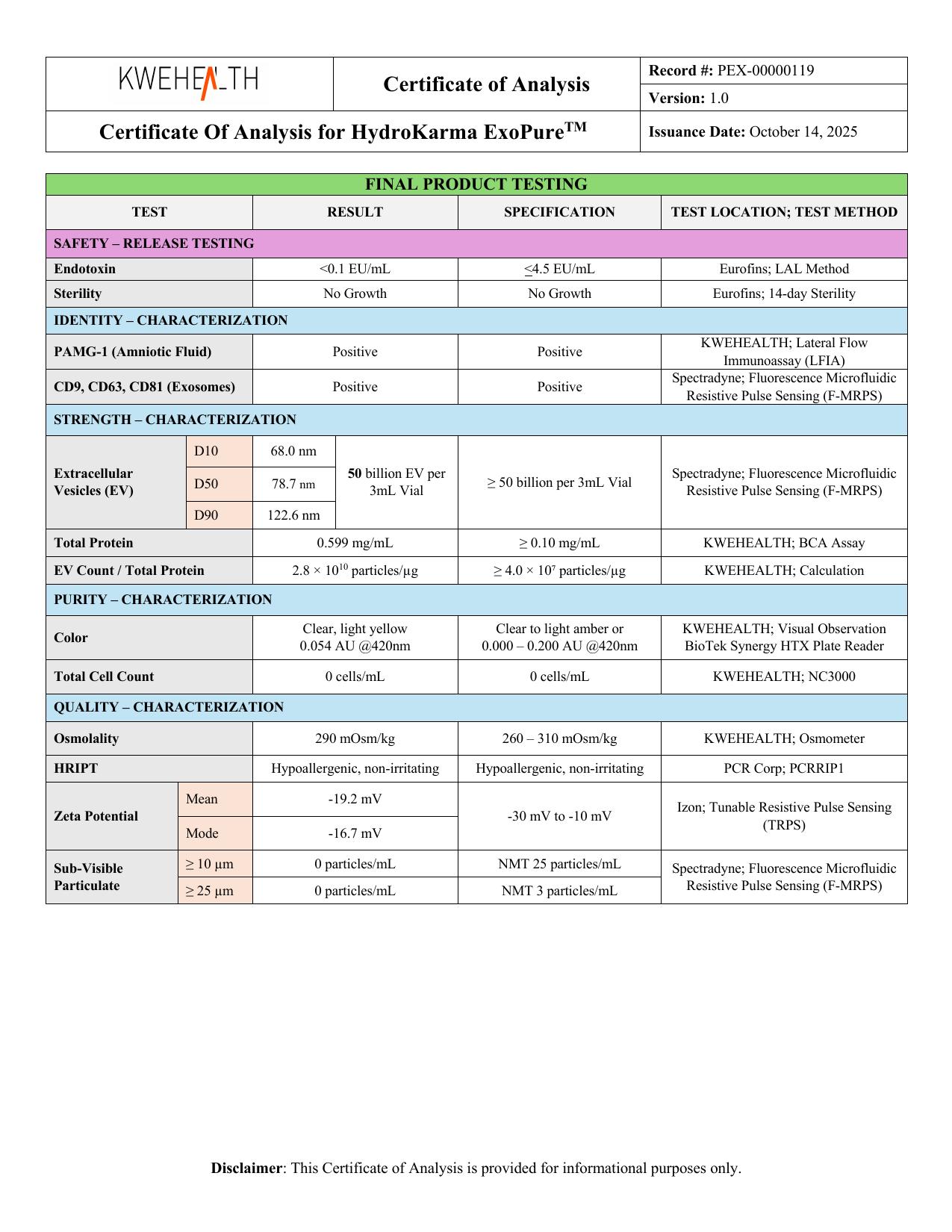
At first glance, someone might read:
50 billion particles
and:
0 particles/mL
and assume the COA contradicts itself.
It doesn't.
The key is the notation:
≥10 µm
and:
≥25 µm
Those size thresholds are enormously larger than the nanoscale particles represented in the EV size distribution.
Nanometers vs. Micrometers
The relationship is:
1 µm = 1,000 nm
That means:
10 µm = 10,000 nm
and:
25 µm = 25,000 nm
Now compare those values with the HydroKarma COA:
D50 = 78.7 nm
versus:
particulate-matter threshold = 10,000 nm
and:
particulate-matter threshold = 25,000 nm
These tests are operating on very different size scales.
Just How Much Larger Is 10 µm Than 78.7 nm?
Using the reported D50 value:
10 µm = 10,000 nm
Then:
10,000 ÷ 78.7 ≈ 127
So a 10 µm particle is roughly 127 times larger in linear diameter than a particle at the reported 78.7 nm D50.
For 25 µm:
25,000 ÷ 78.7 ≈ 318
So a 25 µm particle is roughly 318 times larger in linear diameter than the reported D50.
These are simple size comparisons based on the reported values.
They do not describe particle volume, mass, composition or biological identity.
But they illustrate why the two measurements should not be confused.
What Does “≥10 µm” Mean?
The symbol:
≥
means:
greater than or equal to
Therefore:
Particulate Matter ≥10 µm
refers to particles meeting or exceeding a 10-micrometer size threshold under the applicable test.
It does not mean:
all particles in the vial.
Likewise:
Particulate Matter ≥25 µm
refers specifically to the larger 25-micrometer-and-above threshold.
That distinction is essential.
What Does “0 particles/mL” Mean?
For KH-0007DE, KWEHEALTH reports:
0 particles/mL
at both of the listed particulate-matter thresholds.
The appropriate interpretation is that the reported test result was:
0 particles/mL at ≥10 µm
and:
0 particles/mL at ≥25 µm
under the reported testing conditions.
It should not be shortened to:
“The product contains zero particles.”
That would directly conflict with both the scope of the test and the separately reported EV measurements.
The size threshold is part of the result.
Why the Size Threshold Must Stay Attached to the Number
This is a good example of why units and qualifiers matter so much on a COA.
Compare:
0 particles/mL
with:
0 particles/mL ≥10 µm
Those statements do not mean the same thing.
The second tells us what population of particles the measurement addresses.
Removing:
≥10 µm
changes the meaning.
Likewise, saying:
“No particles were detected”
without mentioning the applicable size threshold would be misleading in a preparation whose COA separately reports billions of nanoscale particles.
EV Particle Count and Particulate Matter Ask Different Questions
The two measurements can be thought of this way:
EV particle analysis asks:
What does the measured nanoscale particle population look like?
Particulate-matter testing asks:
What larger particles are detected at the specified micrometer-scale thresholds?
Those are different analytical questions.
For KH-0007DE, KWEHEALTH reports the EV quantity and size measurements using:
Spectradyne; Fluorescence Microfluidic Resistive Pulse Sensing (F-MRPS)
The COA separately reports the particulate-matter results.
We should not assume that the same analytical method produced both sets of measurements unless the manufacturer documentation explicitly says so.
Does F-MRPS Measure the ≥10 µm and ≥25 µm Results?
In this specific case, the authentic KH-0007DE documentation does identify a method for those rows.
KWEHEALTH's COA lists the sub-visible particulate rows with the method reported as:
Spectradyne; Fluorescence Microfluidic Resistive Pulse Sensing (F-MRPS)
That is reproduced exactly as printed on the manufacturer's batch documentation, and it applies to that lot's reported results only.
The general rule still applies
A method reported for one row of a COA should never be assumed for a different row. Report the method the documentation attaches to the specific result, and when the documentation is silent, say that it does not identify one.
This follows the same rule we've used throughout this Learn library:
When manufacturer documentation tells us the method, report it.
When it doesn't, say that the supplied documentation does not identify it.
How Is Particulate Matter Commonly Measured?
In pharmaceutical quality testing, compendial approaches exist for evaluating particulate matter in injections.
USP General Chapter <788>, Particulate Matter in Injections, describes approaches for measuring subvisible particles.
Two recognized approaches include:
light obscuration particle count testing
and:
microscopic particle count testing.
These methods are worth understanding as general pharmaceutical-testing concepts.
But their existence does not establish which method KWEHEALTH used for KH-0007DE, and the KH-0007DE documentation does not identify either of them.
What Is Light Obscuration?
Imagine a sample flowing through an instrument.
A beam of light passes through the measurement region.
When a sufficiently large particle crosses the beam, it changes the amount of light reaching the detector.
The instrument can use that signal to characterize particles within its measurement range.
Light-obscuration testing is widely associated with pharmaceutical particulate-matter analysis.
Again, that is general analytical education—not a claim that this was HydroKarma's method.
What Is Microscopic Particle Counting?
Instead of relying on an optical sensor as particles pass through an instrument, a microscopic approach allows qualifying particles to be evaluated visually under defined conditions.
Each approach has its own procedures, strengths and limitations.
Why Are 10 µm and 25 µm Common Thresholds?
The 10 µm and 25 µm thresholds appear prominently in pharmaceutical particulate-matter testing because compendial standards use size-based categories when evaluating subvisible particles in injectable preparations.
The important lesson here isn't to memorize a regulatory limit.
It's to understand that:
particulate-matter testing is size-specific.
A reported count only makes sense when interpreted together with:
- the size threshold
- the units
- the method
- the sample
- the applicable specification
We should not assign a USP acceptance criterion to HydroKarma unless the manufacturer documentation establishes that the test was performed and evaluated under that specific standard.
What Does “Subvisible” Mean?
This term can initially be confusing because extracellular vesicles are also far too small to see with the naked eye.
But subvisible particulate matter is a particular analytical concept in pharmaceutical testing.
It should not be treated as a synonym for:
extracellular vesicle
or:
nanoparticle.
Is a 10 µm Particle an Extracellular Vesicle?
Size alone cannot establish biological identity.
However, the important point here is that 10 µm is dramatically larger than the nanoscale EV population represented by the KH-0007DE D10/D50/D90 values.
Recall:
- D10 = 68.0 nm
- D50 = 78.7 nm
- D90 = 122.6 nm
Meanwhile:
10 µm = 10,000 nm
The particulate-matter measurement therefore addresses a vastly larger size range than the central portion of the reported EV size distribution.
For more on interpreting EV size, see What Does Extracellular Vesicle Size Tell Us?.
Does 0 Particles ≥10 µm Mean There Are No Aggregates?
Not necessarily.
We need to be careful here.
The COA reports:
0 particles/mL ≥10 µm
That tells us the reported result at that threshold.
It does not automatically establish:
zero aggregates of every possible size
because smaller aggregates could theoretically exist below that threshold, depending on the sample and analytical method.
Likewise, the test does not by itself tell us the composition or identity of every potential particle.
Therefore:
0 particles/mL ≥10 µm ≠ proof of zero aggregation at every size
Does Particulate Matter Tell Us EV Purity?
No.
Particulate-matter testing and EV purity address different questions.
A preparation could report no particles at the specified ≥10 µm and ≥25 µm thresholds while still containing:
- soluble proteins
- nanoscale non-EV particles
- other nanoscale material
- components of the formulation
Particulate-matter testing does not determine how selectively extracellular vesicles were isolated.
Therefore:
0 particles/mL ≥10 µm ≠ 100% EV purity
For the broader issue of purity, see What Is Extracellular Vesicle Purity?.
Does Particulate Matter Tell Us EV Identity?
No.
Particulate-matter testing does not establish whether nanoscale particles are:
- EVs
- exosomes
- lipoproteins
- protein complexes
- another particle population
EV identity requires other forms of characterization.
See What Are CD9, CD63 and CD81? Understanding Common Extracellular Vesicle Markers and Understanding Extracellular Vesicle Characterization and Testing.
Does Particulate Matter Tell Us Sterility?
No.
A particulate-matter test is not a sterility test.
For KH-0007DE, KWEHEALTH separately reports:
Sterility: No Growth
The particulate-matter results cannot be substituted for the sterility result.
Therefore:
0 particles/mL ≥10 µm ≠ No Growth
and:
0 particles/mL ≥25 µm ≠ proof of sterility
See What Is Sterility Testing? Understanding “No Growth” on a COA.
Does Particulate Matter Tell Us Endotoxin Levels?
No.
KWEHEALTH separately reports:
Endotoxin: <0.1 EU/mL
Endotoxin is measured in:
EU/mL
Particulate matter is reported here in:
particles/mL at defined size thresholds.
These are completely different measurements.
See What Is Endotoxin Testing and Why Does It Matter?.
What About Visible Particles?
Visible-particle inspection and subvisible-particle testing are related quality concepts, but they are not the same measurement.
Particles large enough to be seen during an appropriate visual inspection fall into a different practical category from particles requiring analytical instrumentation or microscopy for reliable detection and counting.
A COA result at:
≥10 µm
or:
≥25 µm
should therefore not automatically be rewritten as:
“No visible particles.”
That would be a different statement unless the documentation separately reports a visual-inspection result.
Why Can't We Compare 50 Billion With 0 Directly?
Because the numbers don't refer to the same population.
Consider an analogy.
Suppose a container held billions of grains of extremely fine powder but a test asked:
How many objects larger than a golf ball are present?
The answer could be:
zero
without implying that the container itself was empty.
The same basic logic applies here.
50 billion EV per 3 mL vial
and:
0 particles/mL ≥10 µm
can coexist because the measurements concern different particle-size populations.
A Better Way to Read the Results
Instead of reading:
50 billion particles
versus:
0 particles
read the actual complete measurements:
- 50 billion EV per 3 mL vial — reported EV quantity
- 0 particles/mL ≥10 µm — reported particulate-matter count at the ≥10 µm threshold
- 0 particles/mL ≥25 µm — reported particulate-matter count at the ≥25 µm threshold
Now the apparent contradiction disappears.
Why Units Are Part of the Scientific Result
Throughout this Learn library, we've repeatedly encountered measurements that become misleading when their units are removed.
Consider:
- 0.599 mg/mL — total protein
- 2.8 × 10¹⁰ particles/µg — particle-to-protein ratio
- −19.2 / −16.7 mV — zeta potential
- <0.1 EU/mL — endotoxin
- 290 mOsm/kg — osmolality
- 0 particles/mL ≥10 µm — particulate matter
The number alone isn't enough.
The units and qualifiers tell you what the number means.
This is one of the most useful habits when reading any technical Certificate of Analysis.
How Should You Read Particulate Matter on a COA?
Use this checklist:
1. Look at the size threshold.
Is the result for ≥10 µm, ≥25 µm or another range?
2. Keep the units attached.
Don't reduce 0 particles/mL ≥10 µm to simply 0 particles.
3. Identify the method if reported.
Don't assume the method.
4. Separate micrometer-scale particulate matter from nanoscale EV measurements.
They answer different analytical questions.
5. Don't turn the result into a purity claim.
Particulate matter ≠ EV purity.
6. Don't turn it into an identity claim.
Particulate matter ≠ exosome identification.
7. Don't turn it into a sterility claim.
Particulate matter ≠ microbiological testing.
8. Interpret the result in the context of the complete COA.
No single measurement tells the whole story.
Putting the HydroKarma Results Together
At this point, we've covered nearly every major measurement appearing in the Final Product Testing section for KH-0007DE.
| Measurement | Reported Result | What It Helps Describe |
|---|---|---|
| EV Quantity | 50 billion EV / 3 mL | Particle quantity |
| D10/D50/D90 | 68.0 / 78.7 / 122.6 nm | Particle-size distribution |
| CD9/CD63/CD81 | Positive | Selected EV-associated markers |
| Total Protein | 0.599 mg/mL | Bulk protein concentration |
| EV Count / Total Protein | 2.8 × 10¹⁰ particles/µg | Particle-to-protein relationship |
| Cell Count | 0 cells/mL | Reported cell count |
| Zeta Potential | −19.2 / −16.7 mV | Electrokinetic characteristics |
| Endotoxin | <0.1 EU/mL | Bacterial endotoxin |
| Sterility | No Growth | Microbial-growth testing |
| Osmolality | 290 mOsm/kg | Osmotic concentration |
| Particulate Matter ≥10 µm | 0 particles/mL | Larger-particle count at specified threshold |
| Particulate Matter ≥25 µm | 0 particles/mL | Larger-particle count at specified threshold |
The important pattern should now be obvious:
Every row answers a different question.
That is why a good COA contains multiple complementary measurements instead of one number labeled:
“Quality.”
For the complete framework, see How to Read an Exosome Certificate of Analysis (COA).
The Bottom Line
HydroKarma lot KH-0007DE can simultaneously report:
50 billion EV per 3 mL vial
and:
- 0 particles/mL ≥10 µm
- 0 particles/mL ≥25 µm
without any contradiction.
Why?
Because the measurements are looking at different particle-size ranges.
The COA reports a nanoscale EV size distribution with:
- D10 = 68.0 nm
- D50 = 78.7 nm
- D90 = 122.6 nm
while:
10 µm = 10,000 nm
and:
25 µm = 25,000 nm
Particulate-matter testing therefore should not be confused with EV particle counting.
And the 0 particles/mL result should never be separated from its size threshold and rewritten as:
“zero particles in the product.”
As with every COA result, the key is to ask:
The useful question
What exactly was measured, at what size range, using what units, and what does the test actually allow us to conclude?
Related reading: How Are Extracellular Vesicle Particle Counts Measured?
Original Source / References
- United States Pharmacopeia — General Chapter <788>, Particulate Matter in Injections. USP <788> provides compendial approaches for evaluating subvisible particulate matter in injections, including light obscuration and microscopic particle count concepts and defined size thresholds.
- United States Pharmacopeia — General Chapter <790>, Visible Particulates in Injections. USP <790> addresses visual inspection for visible particulate matter and should be distinguished from subvisible particulate-matter testing.
- KWEHEALTH/HydroKarma batch-specific Certificate of Analysis — Lot KH-0007DE. The EV quantity, D10/D50/D90 and sub-visible particulate results discussed here are manufacturer-supplied batch-specific data reproduced as printed, and should not be attributed to USP or generalized to other lots.
Continue Learning
What Does “0 Cells/mL” Mean on an Extracellular Vesicle COA?
A COA can report 0 cells/mL and 50 billion EV per 3 mL vial at the same time. Here's why cells and extracellular vesicles are not the same measurement.
What Is Extracellular Vesicle Size and Why Does It Matter?
Extracellular vesicles exist across a range of nanoscale sizes. Here's what nanometer measurements mean, how D10, D50 and D90 describe a size distribution, and why size is one piece of characterization evidence rather than proof of identity.
How Are Extracellular Vesicle Particle Counts Measured?
A Certificate of Analysis can report billions of particles — but how does a laboratory arrive at that number? A plain-English guide to RPS, MRPS, NTA, flow cytometry and why the method behind a particle count matters.
How to Read an Exosome Certificate of Analysis (COA)
A plain-English walkthrough of an extracellular-vesicle Certificate of Analysis: lot numbers, analytical methods, particle concentration, particle size, characterization, specifications and results.