
Quality & Transparency
Quality You Can Verify
Quality isn't just a claim. The biologics offered through Express Biologics are supported by documented manufacturing controls, donor screening, product characterization, independent laboratory testing, and batch-specific Certificates of Analysis.
- Documented Manufacturing Controls
- Independent Laboratory Testing
- Batch-Specific COAs
- Controlled Cold-Chain Fulfillment
Manufacturing Controls
cGMP Manufacturing & Controlled Environment
Products are manufactured under a documented quality program designed around Current Good Manufacturing Practices (cGMP). Manufacturing takes place in an ISO-certified controlled environment using aseptic techniques intended to help prevent contamination and cross-contamination.
Environmental monitoring and quality-assurance procedures are incorporated into the manufacturing program to support controlled production and established product specifications prior to release.
Facility & Process Walkthrough
From intake through cold-chain fulfillment.
Coming soon
cGMP Quality Program
Documented manufacturing and quality-control procedures.
ISO-Certified Controlled Environment
Controlled manufacturing conditions designed to support product consistency and quality.
Aseptic Processing
Aseptic techniques are used to help prevent contamination and cross-contamination.
Environmental Monitoring
Environmental monitoring is incorporated into the manufacturer's quality program.
Source Controls
Quality Starts at the Source
For donor-derived biologic products, quality begins before manufacturing. Donor eligibility procedures include medical-record review, health and risk assessment, and infectious-disease screening designed to evaluate donor suitability before source material enters the manufacturing process.
Documented Donor Screening
Documented screening includes review of donor records by a licensed physician along with serology and nucleic-acid testing for relevant communicable diseases before source material enters manufacturing. Screening information is recorded and identified on the applicable batch-specific Certificate of Analysis.
Third-Party Verification
Testing Beyond the Manufacturer
Quality evaluation includes both manufacturer-performed characterization and testing conducted by independent laboratories. Batch-specific Certificates of Analysis identify testing information, methods, specifications, results, and laboratory information where applicable—providing greater visibility into how product characteristics are evaluated.
Independent Laboratory
Eurofins
Donor infectious-disease serology and nucleic-acid screening, endotoxin testing (LAL method), and 14-day sterility testing.
Independent Laboratory
Spectradyne
Exosome-marker identification (CD9, CD63, CD81), extracellular-vesicle count and size distribution, and sub-visible particulate analysis by F-MRPS.
Independent Laboratory
PCR Corp
Human Repeat Insult Patch Testing (HRIPT) for irritation and sensitization.
Independent Laboratory
Izon
Zeta-potential characterization by Tunable Resistive Pulse Sensing (TRPS).
Testing laboratories and methods may vary by product and batch. The applicable Certificate of Analysis provides batch-specific information.
Not all testing is performed independently. Characterization such as identity by immunoassay, total protein, cell count, appearance, and osmolality is performed by the manufacturer and is identified as such on the Certificate of Analysis.
Product Characterization
What Is Actually Tested?
Depending on the product, testing and characterization evaluate multiple aspects of safety, identity, strength, purity, and quality.
Safety
- Endotoxin
- Sterility
Release testing evaluates specified safety-related parameters before a batch is released.
Identity
- PAMG-1
- CD9
- CD63
- CD81
Identity testing confirms the expected source material and canonical extracellular-vesicle markers.
Strength
- Extracellular-vesicle count
- Particle-size distribution (D10/D50/D90)
- Total protein
- EV count / total protein
Quantitative characterization provides measurable information about composition and batch consistency.
Purity
- Color / absorbance
- Total cell count
Purity characterization evaluates specified attributes such as appearance and the absence of cells.
Quality
- Osmolality
- HRIPT
- Zeta potential
- Sub-visible particulate
Additional characterization covers physical properties, tolerability testing, particle stability, and particulate levels.
Testing specifications and results vary by product and batch. Refer to the applicable Certificate of Analysis for batch-specific testing and results.
Want the detail behind these tests? How extracellular vesicles are characterized and tested.
Documentation & Transparency
Know What's in Your Batch
Each batch includes a Certificate of Analysis (COA), giving customers clear, batch-specific information about the product they're purchasing. Rather than relying solely on general quality claims, customers can review documented testing and characterization associated with the applicable batch.
Depending on the product, a COA may include information such as lot identification, manufacturing and release information, testing specifications, test results, test methods, laboratory information, product characterization, and storage requirements.
Plain-English Guide
Understanding Your Certificate of Analysis
Not familiar with laboratory reports? This short guide explains what a Certificate of Analysis is, where to find important batch information, and how to understand the testing and characterization documented for a product.
Understanding Your COA
A quick guide to reading batch-specific documentation.
Coming soon
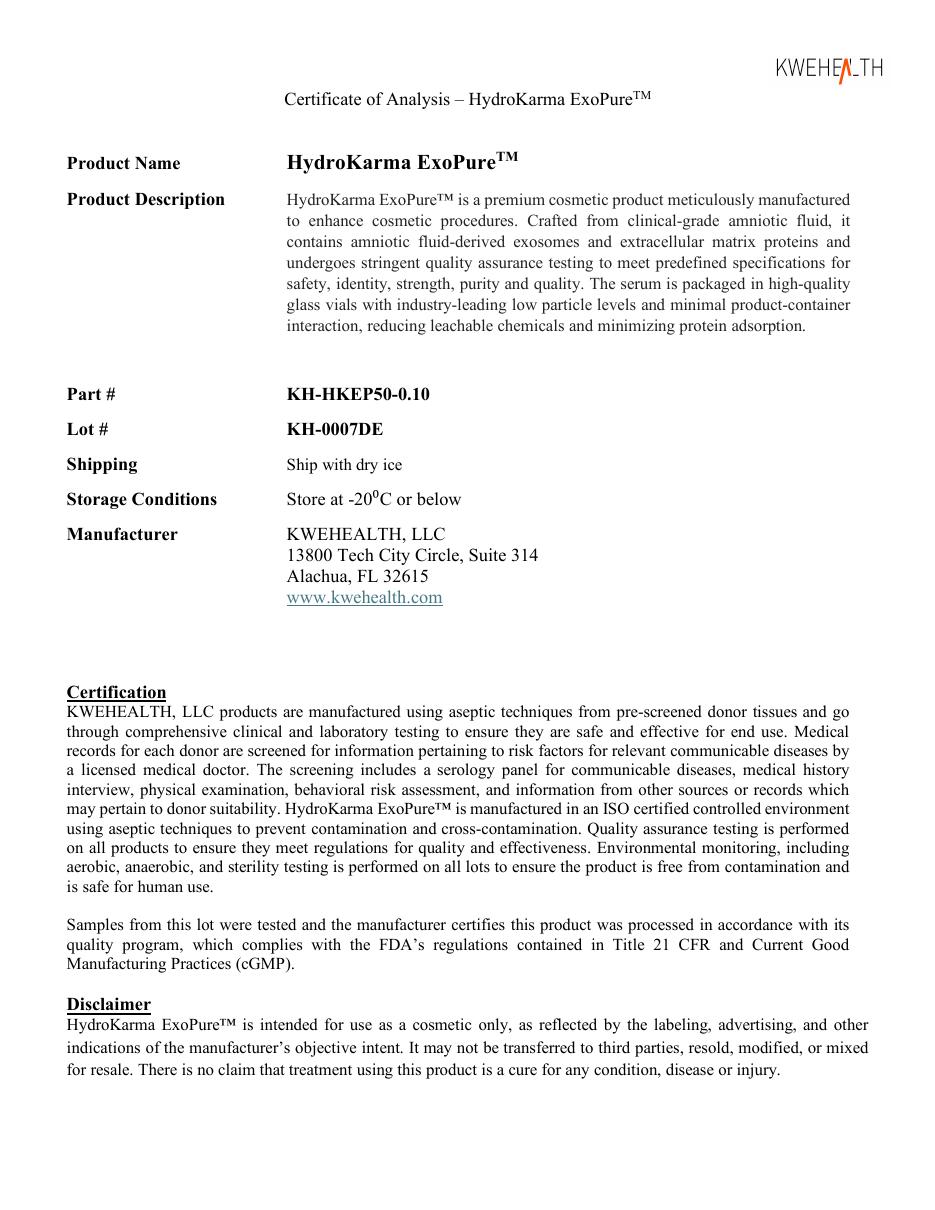
Sample Certificate of Analysis
A real batch document, shown exactly as issued.
View an authentic batch Certificate of Analysis.
View Sample COANew to batch documentation? How to read a Certificate of Analysis and what should appear on one.
Want to See a Real Batch COA?
Batch-specific Certificates of Analysis are available from the individual product pages, where visitors can review the documentation associated with each listed product.
View Products & DocumentationStorage & Fulfillment
Cold-Chain Care Through Delivery
Temperature-sensitive biologic products are maintained under controlled frozen storage prior to fulfillment and prepared for shipment directly from HydroKarma's facility. Product-specific storage and handling requirements are followed throughout fulfillment, with exact storage instructions provided for each product.
Step 1
Controlled Frozen Storage
Step 2
Order Preparation
Step 3
Insulated Packaging + Dry Ice
Step 4
Monday–Thursday Dispatch
Step 5
UPS Overnight
Step 6
Prompt Freezer Storage Upon Arrival
Orders are packed in insulated packaging with dry ice and shipped via UPS overnight service to minimize transit time. Monday-through-Thursday dispatch helps reduce the possibility of temperature-sensitive products being held in the carrier network over a weekend. Tracking information is provided so customers can plan for delivery and place products into proper storage promptly upon arrival.
Orders placed by 2:45 PM ET on eligible shipping days are processed for next-business-day delivery. Orders placed after the cutoff are processed on the next eligible shipping day. Orders ship Monday through Thursday.
According to KWEHEALTH, an unopened frozen HydroKarma vial can be stored for up to 6 months at −20°C or up to 2 years at −80°C.
Exact storage requirements vary by product. Always follow the storage instructions provided with the product.
More on why this matters: Cold-chain storage and handling for exosome products.
Go Deeper
Understand the Testing Behind the Documentation
Educational guides that explain the testing, manufacturing controls and cold-chain practices described on this page.
Understanding Extracellular Vesicle Characterization and Testing
How laboratories characterize a batch, and with which methods.
ReadHow to Read an Exosome Certificate of Analysis (COA)
Walk through a Certificate of Analysis line by line.
ReadWhat Does cGMP Mean? A Beginner's Guide to Manufacturing Quality
What cGMP covers in practice, in plain English.
ReadWhat Is Cold-Chain Storage and Why Does It Matter?
Why frozen storage and transit handling matter for biologics.
ReadTransparency Builds Confidence.
Review the documentation, understand the process, and know more about the products you're purchasing.