
Quality, Testing & COAs
What Is Endotoxin Testing and Why Does It Matter?
A Certificate of Analysis may report “Endotoxin: <0.1 EU/mL.” Here's what Endotoxin Units mean, why endotoxin testing isn't sterility testing, and what a result like that does — and doesn't — establish.
When reading a Certificate of Analysis, you may see a result such as:
Endotoxin: <0.1 EU/mL
At first glance, that looks like another microbiology result.
But endotoxin testing is not the same thing as sterility testing, and the unit EU/mL does not describe bacteria per milliliter.
Endotoxin testing asks a different question:
How much detectable bacterial endotoxin is present in the tested sample under the conditions of the assay?
Understanding that distinction makes this section of a Certificate of Analysis much easier to interpret.
What Is Endotoxin?
Endotoxins are components associated with the outer membrane of Gram-negative bacteria. They are commonly associated with lipopolysaccharide, or LPS. FDA and USP bacterial-endotoxin testing guidance addresses methods used to detect or quantify these endotoxins in appropriate products and samples.
An important point is that detecting endotoxin is not the same thing as detecting a living bacterial cell.
Endotoxin material can remain even when viable bacteria are no longer present.
That is one reason endotoxin testing and sterility testing answer different questions.
Endotoxin Testing vs. Sterility Testing
This distinction is fundamental.
| Test | Basic Question |
|---|---|
| Sterility testing | Was microbial growth detected under the conditions of the test? |
| Endotoxin testing | How much detectable bacterial endotoxin is present under the conditions of the assay? |
A sterility result of:
No Growth
doesn't automatically mean:
No endotoxin.
Likewise, an endotoxin result doesn't replace sterility testing.
FDA's current pyrogen/endotoxin guidance treats endotoxin testing and broader microbiological/product-quality controls as distinct considerations rather than interchangeable tests.
So:
Key distinctions
sterility ≠ endotoxin — and endotoxin result ≠ sterility result
What Does EU Mean?
Endotoxin results are commonly reported in:
EU
which stands for:
Endotoxin Units
A liquid sample may therefore be reported as:
EU/mL
or:
Endotoxin Units per milliliter.
EU is not the same thing as:
- bacterial cells/mL
- colony-forming units/mL
- particles/mL
- protein concentration
- EV concentration
So a result such as:
<0.1 EU/mL
should not be interpreted as:
“fewer than 0.1 bacteria per milliliter.”
Those are entirely different measurements.
Why Test for Endotoxin?
Because microbiological quality cannot be fully understood by asking only whether living microorganisms are detected.
Gram-negative bacterial material can contain endotoxin even after the bacteria themselves are no longer viable.
That makes endotoxin a separate analytical target.
For products or materials where endotoxin control is relevant, testing provides another layer of quality information alongside:
- sterility
- environmental monitoring
- aseptic processing
- manufacturing controls
- other lot-specific testing
This connects directly with What Is Aseptic Processing? A Beginner's Guide to Contamination Control.
Aseptic processing focuses on reducing opportunities for microbial contamination during manufacturing.
Endotoxin testing evaluates a specific bacterial component in the tested sample.
Those are related—but different—parts of contamination control.
What Is the Bacterial Endotoxins Test?
The Bacterial Endotoxins Test, often abbreviated BET, is the general term for testing used to detect or quantify bacterial endotoxins.
USP General Chapter <85> describes bacterial-endotoxin testing using methodologies based on reagents that react with bacterial endotoxin. USP describes the chapter as a test for detecting or quantifying endotoxins from Gram-negative bacteria.
Historically, many endotoxin assays have used Limulus amebocyte lysate, commonly called LAL.
However, endotoxin-testing technology is evolving.
USP has also developed Chapter <86> covering additional bacterial-endotoxin testing techniques based on non-animal-derived reagents, and FDA updated its endotoxin guidance in 2026 to reflect a broader range of recombinant testing approaches.
That means the broader term Bacterial Endotoxins Test can be more useful than assuming every modern endotoxin result necessarily came from one exact LAL configuration.
What Is LAL Testing?
LAL-based testing became widely used because the reagent produces a measurable response when exposed to endotoxin.
Different implementations can produce that response in different ways.
USP <85> includes principles associated with methods such as:
- gel-clot
- photometric
- kinetic techniques
FDA also recognizes these established approaches in its endotoxin-testing framework.
For a reader interpreting a COA, however, the main point isn't memorizing every assay format.
It's understanding:
What the assay is for
the assay is designed to detect or quantify endotoxin—not extracellular vesicles.
Endotoxin Testing Does Not Count Extracellular Vesicles
This should be obvious once the two measurements are explained, but it's worth stating explicitly.
An EV particle-analysis method may report:
particles/mL
An endotoxin assay may report:
EU/mL
Those units answer completely different questions.
For example:
50 billion EV per 3 mL vial
and:
<0.1 EU/mL endotoxin
should not be mathematically combined into some kind of EV-purity percentage.
The particle measurement characterizes the nanoscale particle population.
The endotoxin result characterizes detectable bacterial-endotoxin activity according to the relevant test.
A Real HydroKarma Example
KWEHEALTH's batch-specific Certificate of Analysis for HydroKarma lot KH-0007DE reports:
Endotoxin: <0.1 EU/mL
The same COA separately reports:
Sterility: No Growth
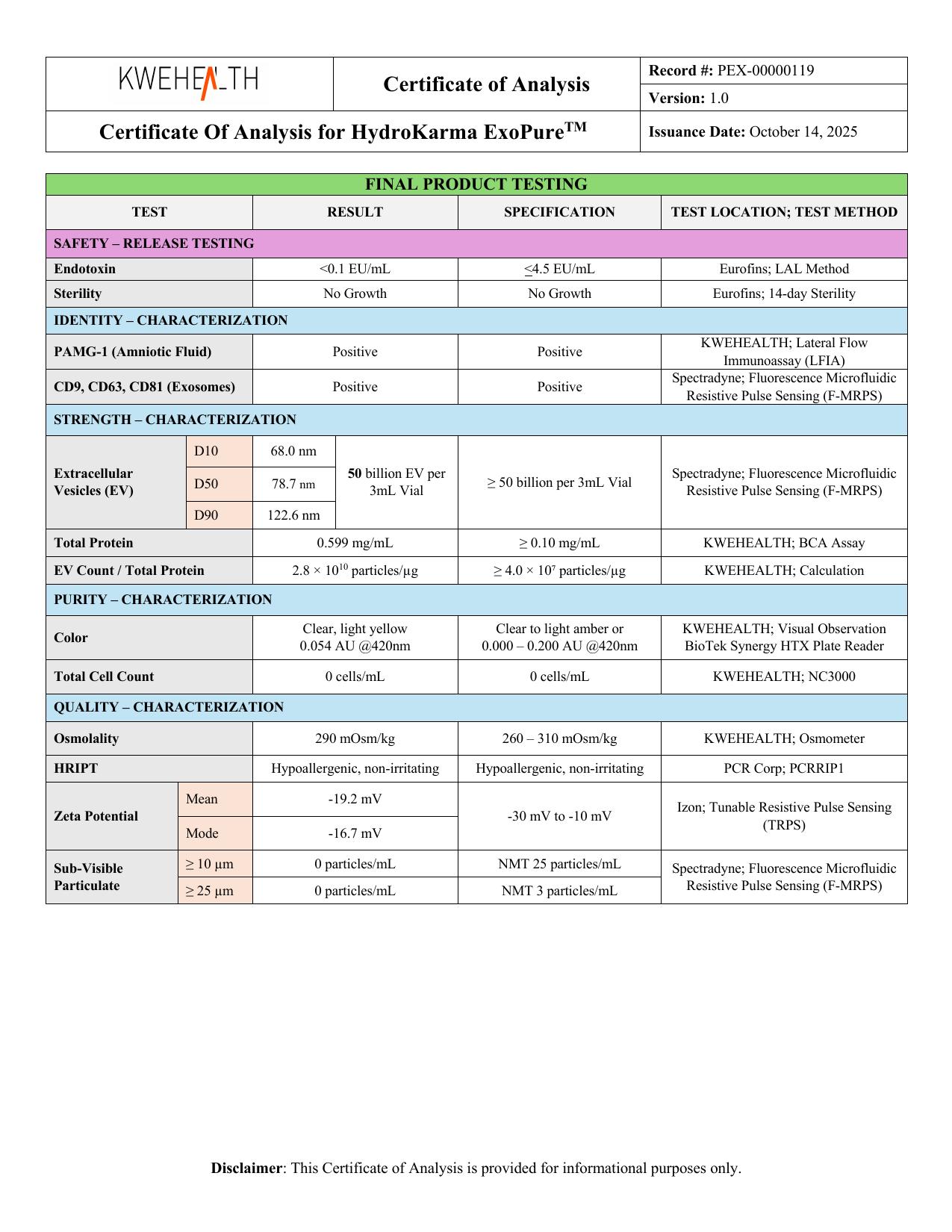
Those are two different lot-specific results.
The endotoxin result tells us that KWEHEALTH reports the measured endotoxin value as being below 0.1 EU/mL for that lot.
The sterility result tells us that KWEHEALTH reports No Growth under the sterility test shown on the COA.
Neither result should be substituted for the other.
What Does the “<” Symbol Mean?
The symbol:
<
means:
less than
So:
<0.1 EU/mL
means the reported result is:
less than 0.1 Endotoxin Units per milliliter.
It does not mean exactly:
0.1 EU/mL
and it should not be rewritten as:
0 EU/mL.
That distinction matters.
The accurate statement is simply:
What we can say
KWEHEALTH reports endotoxin at <0.1 EU/mL for lot KH-0007DE.
Does <0.1 EU/mL Mean “Zero Endotoxin”?
No.
A result reported as:
<0.1 EU/mL
should not be converted into:
“zero endotoxin.”
The result tells us that the measured value was below the stated reporting level or criterion represented by that result.
That's different from proving the absolute absence of every endotoxin molecule.
This is the same analytical principle we've used elsewhere in the Learn library:
Report what the test tells us without stretching the result beyond its measurement.
Does “No Growth” Mean There Can't Be Endotoxin?
No.
Sterility testing is concerned with microbial growth under defined conditions.
Endotoxin testing detects or quantifies bacterial endotoxin.
Because endotoxin material can exist independently of viable bacterial growth, the two results need to be evaluated separately.
That is why a COA can reasonably contain both:
Sterility
and:
Endotoxin
as separate rows.
They're not redundant.
Endotoxin Is Not the Same as Every Pyrogen
Another term you may encounter is:
pyrogen
A pyrogen is something capable of producing a fever response.
Bacterial endotoxins are an important class of pyrogen, but the terms pyrogen and endotoxin should not automatically be treated as synonyms.
FDA's current guidance specifically discusses pyrogen and endotoxin testing separately because endotoxin-focused tests do not necessarily detect every possible non-endotoxin pyrogen.
So:
Terminology
endotoxin = specific bacterial target, while pyrogen = broader concept
That distinction is useful when evaluating technical documentation.
Why Can Endotoxin Testing Be Technically Challenging?
Analytical assays don't operate in a vacuum.
The product or sample being tested can potentially interfere with the test response.
Depending on the sample, interference may:
- suppress the expected response
- enhance the response
- affect recovery of a known endotoxin spike
- otherwise complicate interpretation
That is why established endotoxin-testing frameworks include concepts such as method suitability and controls designed to determine whether the sample interferes with the assay. FDA guidance specifically discusses the need to address product interference when applying bacterial-endotoxin tests.
This is another reason a COA result is more meaningful when the underlying test has been appropriately established for the material being evaluated.
What Is Spike Recovery?
One way to investigate whether a sample interferes with an endotoxin assay is to introduce a known amount of endotoxin and determine whether the assay recovers an appropriate response.
The basic question is:
If we know endotoxin was added, can the assay still detect it appropriately in this particular sample?
This helps identify possible interference from the sample itself.
The exact acceptance criteria and validation approach depend on the test framework being used.
Why Does the Sample Matrix Matter?
The word matrix simply describes everything surrounding the analyte being measured.
For an EV preparation, that could include:
- buffer components
- proteins
- salts
- other biological material
- formulation components
Those materials may interact with an analytical assay.
So a method that works perfectly in purified water isn't automatically guaranteed to behave identically in every complex biological preparation.
This concept isn't unique to endotoxin testing.
It's a general principle of analytical chemistry:
the sample itself can influence the measurement.
Endotoxin Testing Is Not an EV Characterization Test
It's also useful to separate endotoxin testing from the EV-characterization measurements we've spent many articles examining.
Consider:
| Measurement | What It Helps Evaluate |
|---|---|
| Particle quantity | Detected particle amount |
| Particle size | Size distribution |
| CD9/CD63/CD81 | Selected EV-associated markers |
| Total protein | Bulk protein concentration |
| Zeta potential | Electrokinetic behavior under test conditions |
| Endotoxin | Detectable bacterial endotoxin |
| Sterility | Microbial growth under test conditions |
Endotoxin testing therefore belongs more naturally to quality/release testing than to measurements intended to establish EV particle characteristics.
Our guide Understanding Extracellular Vesicle Characterization and Testing explains why these different categories should be read separately.
How Does This Fit With cGMP?
In What Does cGMP Mean? A Beginner's Guide to Manufacturing Quality, we explained that quality should not depend only on testing a finished vial.
Manufacturing controls can involve:
- procedures
- facilities
- equipment
- materials
- personnel
- environmental controls
- documentation
- testing
Endotoxin testing fits into that broader picture as one analytical quality-control measurement.
A good manufacturing system doesn't simply say:
We'll test the finished product and hope everything went correctly.
Instead, process controls and final-product testing can provide different layers of assurance and information.
How Should You Read an Endotoxin Result on a COA?
When you encounter endotoxin testing, ask:
1. What result is reported?
For example:
<0.1 EU/mL
2. What are the units?
EU/mL is different from particles/mL or CFU/mL.
3. Is the result exact or below a reporting threshold?
<0.1 should not be rewritten as 0.1 or 0.
4. What method was used?
If the COA identifies the test method, that provides additional context.
5. Was method suitability established?
The sample matrix can influence analytical tests.
6. Is the result being confused with sterility?
They answer different questions.
7. Is someone claiming more than the test establishes?
An endotoxin result doesn't establish EV identity, particle concentration, purity or biological activity.
These are exactly the kinds of distinctions discussed in How to Read an Exosome Certificate of Analysis (COA).
The Bigger Picture
The HydroKarma COA we've been examining now starts to make much more sense when each row is treated as its own analytical question.
Particle count: How many particles were reported?
Particle size: What size distribution was measured?
Markers: Were selected EV-associated proteins detected?
Protein: How much total protein was measured?
Zeta potential: What electrokinetic values were reported?
Sterility: Was microbial growth reported?
Endotoxin: What level of bacterial endotoxin was reported?
No one test substitutes for all the others.
That's why a well-structured COA contains multiple kinds of information.
The Bottom Line
Endotoxin testing evaluates bacterial endotoxin, a component associated with Gram-negative bacteria.
It is different from:
- sterility testing
- particle counting
- EV-marker analysis
- protein measurement
- purity characterization
Results are commonly reported in Endotoxin Units, such as:
EU/mL
For HydroKarma lot KH-0007DE, KWEHEALTH reports:
Endotoxin: <0.1 EU/mL
That means:
less than 0.1 Endotoxin Units per milliliter
as reported for that batch.
It does not mean:
- zero endotoxin
- 0.1 bacteria/mL
- sterile
- EV purity
- exosome identity
- particle concentration
The useful question is simply:
The useful question
What was tested, what does the unit mean, and what does that particular result actually tell us?
That approach turns another technical-looking COA row into information that is much easier to understand.
Original Source / References
- United States Pharmacopeia — USP General Chapter <85>, Bacterial Endotoxins Test. USP <85> describes established bacterial-endotoxin testing principles and methodologies for detecting or quantifying endotoxins from Gram-negative bacteria.
- FDA — Pyrogen and Endotoxins Testing: Questions and Answers (guidance for industry, March 2026). FDA's guidance discusses bacterial-endotoxin testing, test methods, interference, method suitability and the relationship between endotoxin and broader pyrogen testing.
- United States Pharmacopeia — USP General Chapter <86>, bacterial-endotoxin testing using non-animal-derived reagents. USP <86> provides additional bacterial-endotoxin testing techniques using recombinant/non-animal-derived reagents alongside the established approaches in <85>.
- KWEHEALTH/HydroKarma batch-specific Certificate of Analysis — Lot KH-0007DE. The HydroKarma-specific <0.1 EU/mL endotoxin result and No Growth sterility result discussed above come from manufacturer-supplied batch documentation. They are not results from the independent or compendial sources above, and the COA rows discussed here do not identify a specific endotoxin assay format.
Continue Learning
What Is Sterility Testing? Understanding “No Growth” on a COA
A Certificate of Analysis may report “Sterility: No Growth.” Here's what that result means under the conditions of the test, why sterility testing isn't endotoxin testing, and why sampling limitations matter.
What Is Aseptic Processing? A Beginner's Guide to Contamination Control
Aseptic processing uses controlled practices, environments, equipment, and procedures intended to prevent microbial contamination during manufacturing — which is not the same as a cleanroom classification, cGMP, or a sterility test result.
What Does cGMP Mean? A Beginner's Guide to Manufacturing Quality
cGMP stands for Current Good Manufacturing Practice — a framework of manufacturing systems and quality controls, not a single test, cleanroom classification, or certificate.
How to Read an Exosome Certificate of Analysis (COA)
A plain-English walkthrough of an extracellular-vesicle Certificate of Analysis: lot numbers, analytical methods, particle concentration, particle size, characterization, specifications and results.