
Quality, Testing & COAs
What Is Extracellular Vesicle Purity? How EV Purity Is Evaluated
Extracellular vesicle purity is a multidimensional characterization question, not a single number on a Certificate of Analysis. Here's how particle counts, protein measurements, markers and particle-to-protein ratios each contribute — and what none of them establish alone.
When evaluating an extracellular vesicle preparation, it's natural to ask a seemingly simple question:
How pure is it?
The answer is more complicated than looking for one number on a Certificate of Analysis.
Extracellular vesicle preparations can contain EVs alongside proteins, lipoproteins, cellular material and other components originating from the biological source or introduced during processing. Different isolation and purification approaches can also produce preparations with different characteristics.
As a result, extracellular vesicle purity isn't generally established by one measurement alone.
Researchers instead use multiple measurements to characterize what is present in a preparation and to better understand the relationship between EV-associated particles and other material.
That distinction becomes particularly important when interpreting particle counts, protein measurements and EV-associated markers on a Certificate of Analysis.
What Does “Purity” Mean for Extracellular Vesicles?
In everyday language, pure often sounds absolute:
Something is either pure or it isn't.
Extracellular vesicle science isn't quite that simple.
An EV preparation begins with a complex biological source containing many different components. Processing methods are used to separate or enrich extracellular vesicles from other material.
The resulting preparation can then be characterized to better understand its composition.
Importantly, purity isn't the same thing as simply detecting extracellular vesicles.
A preparation can contain EV-associated particles while also containing other biological material.
That's why characterization generally asks several different questions rather than relying on a single test.
Why Is EV Purity Complicated?
Extracellular vesicles exist in complex biological environments.
Depending on the source material, a preparation may contain or encounter components such as:
- soluble proteins
- protein aggregates
- lipoprotein particles
- cellular debris
- membrane fragments
- other non-EV particles
- residual material associated with the biological source
Some of these components can overlap with EVs in characteristics such as size or density.
That makes separating and characterizing extracellular vesicles technically challenging.
It also explains why a measurement that detects particles shouldn't automatically be interpreted as measuring pure extracellular vesicles.
As discussed in Understanding Exosome Concentration and Particle Count, particle-count measurements tell us something important—but they don't independently establish the identity of every detected particle.
Purification and Characterization Are Different
These two concepts are closely related, but they aren't interchangeable.
Purification refers to processing intended to separate or enrich EVs relative to other material.
Characterization refers to measurements used to describe the resulting preparation.
A purification process might attempt to remove unwanted components.
Characterization then helps evaluate what the resulting preparation looks like.
That's why the manufacturing process and analytical testing need to be considered separately.
Our guide How Are Exosomes Produced and Processed? discusses this distinction in the context of EV processing.
Does a High Particle Count Mean High Purity?
No.
This is one of the most important concepts to understand.
Suppose two preparations both report:
50 billion particles
That number alone doesn't tell us whether the two preparations have comparable purity.
One preparation could contain a different amount of non-EV material than the other.
Likewise, a preparation reporting more particles isn't automatically purer than one reporting fewer particles.
Particle quantity answers:
How many particles were detected under the measurement conditions?
Purity asks a broader question:
What is the composition of the preparation relative to the EV population we're trying to characterize?
Those are different questions.
Therefore:
High particle count ≠ high EV purity
Does Particle Size Establish Purity?
No.
Particle-size measurements are valuable for characterizing the size distribution of detected particles.
But size alone doesn't establish identity.
Different biological particles can occupy overlapping size ranges.
So even if a preparation contains many particles within a size range commonly associated with extracellular vesicles, that doesn't prove that every particle in that range is an EV—or that the preparation is free of non-EV material.
The same principle applies throughout EV characterization:
Particle size ≠ particle identity — and particle size ≠ purity
Do CD9, CD63 and CD81 Prove Purity?
Again, no.
As we explained in What Are CD9, CD63 and CD81? Understanding Common Extracellular Vesicle Markers, these tetraspanins are commonly evaluated EV-associated proteins.
Detecting them can contribute useful characterization evidence.
But detecting CD9, CD63 and CD81 doesn't independently tell us how much non-EV material is present.
Marker testing and purity assessment therefore answer different questions.
Think of it this way:
- EV-associated markers: Are certain proteins commonly associated with EVs detected?
- Purity-related characterization: What can we learn about the relationship between EV-associated particles and other material in the preparation?
Both can be useful.
Neither replaces the other.
Protein Measurements Can Provide Additional Information
Proteins are naturally present in biological samples and EV preparations.
Measuring total protein can therefore provide another piece of characterization information.
But total protein by itself doesn't establish EV purity either.
Why?
Because extracellular vesicles themselves contain proteins.
So a protein measurement isn't simply a measurement of “contamination.”
Instead, researchers sometimes consider particle measurements relative to protein measurements as one way of describing an EV preparation.
This leads us to an important concept: particle-to-protein ratio.
What Is a Particle-to-Protein Ratio?
A particle-to-protein ratio compares the number of measured particles with the amount of measured protein.
Conceptually:
Particle-to-protein ratio = measured particle quantity ÷ measured protein quantity
For example, the result might be expressed as:
particles/µg of protein
A higher ratio means more measured particles relative to the measured amount of protein.
Historically, particle-to-protein relationships have been explored as one possible indicator for comparing EV preparations.
However, this ratio needs to be interpreted carefully.
It is a characterization metric, not an absolute purity certificate.
Why Isn't Particle-to-Protein Ratio a Perfect Purity Score?
Because both sides of the equation have limitations.
The particle measurement may include particles that aren't EVs depending on the analytical technique and preparation.
The protein measurement includes proteins associated with EVs themselves as well as potentially other proteins present in the preparation.
Measurement methods can also differ between laboratories.
That means you shouldn't take two unrelated products, compare their particle-to-protein ratios and automatically declare the larger number “purer” without understanding:
- how the particles were measured
- how protein was measured
- the biological source
- the preparation method
- the analytical methods
- what other characterization data are available
Context matters.
A Real Example From the HydroKarma COA
The KWEHEALTH/HydroKarma Certificate of Analysis for lot KH-0007DE provides an example of how these measurements can appear in actual product documentation.
According to KWEHEALTH's batch-specific COA, the lot reports:
| Measurement | Reported Result |
|---|---|
| EV quantity | 50 billion EV per 3 mL vial |
| Total protein | 0.599 mg/mL |
| EV Count / Total Protein | 2.8 × 10¹⁰ particles/µg |
| Total cell count | 0 cells/mL |
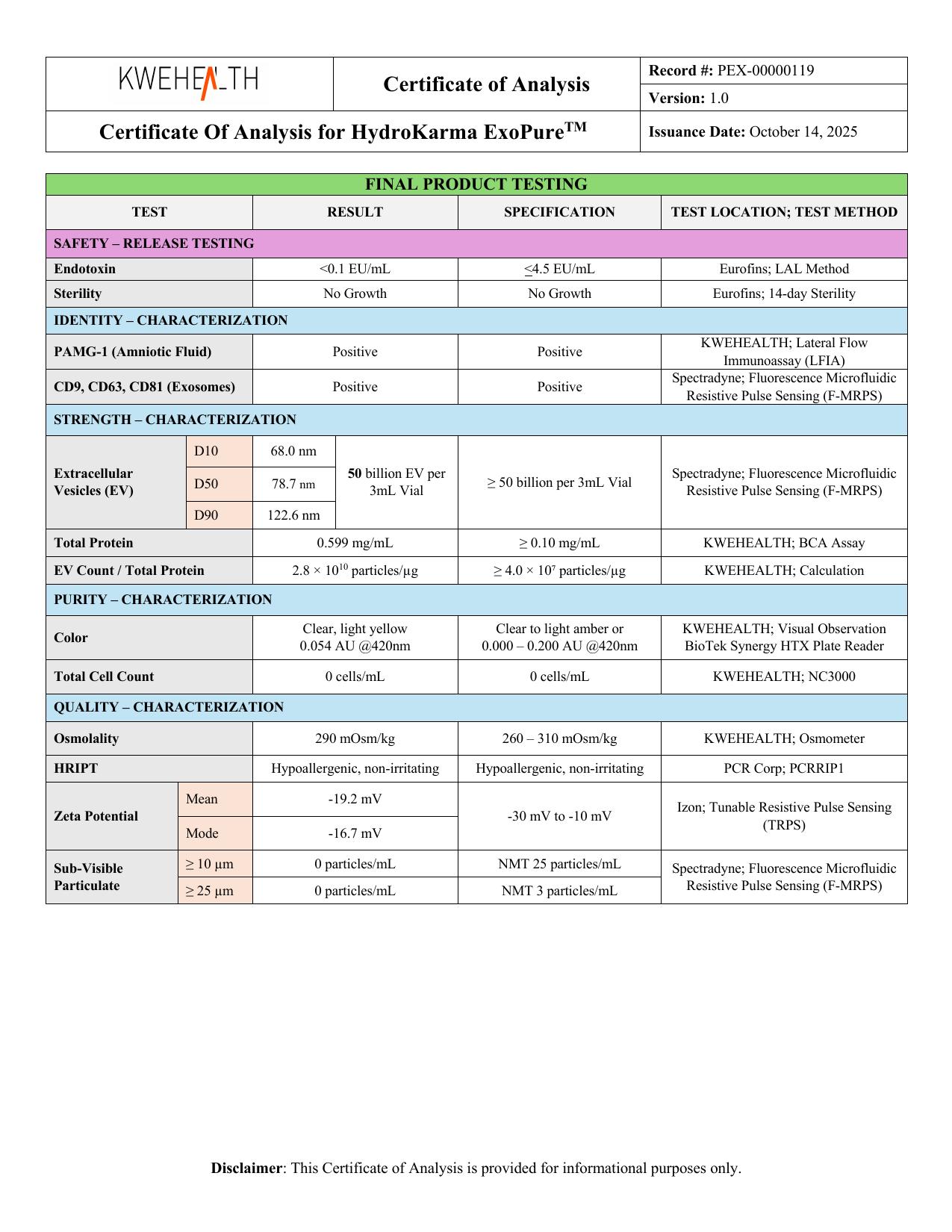
The COA identifies the particle-analysis method for the EV quantity/size measurement as:
Spectradyne; Fluorescence Microfluidic Resistive Pulse Sensing (F-MRPS)
and reports total protein using:
BCA Assay
The 2.8 × 10¹⁰ particles/µg value is therefore a reported characterization measurement for this particular lot.
It should not be interpreted as a universal threshold proving that a preparation is “pure.”
Nor should it be assumed to apply to every HydroKarma lot.
These are lot-specific manufacturer-reported results.
What Does the BCA Assay Measure?
The BCA assay—short for bicinchoninic acid assay—is a commonly used method for estimating protein concentration.
The assay produces a measurable signal related to the amount of protein present in a sample.
In the KH-0007DE COA, KWEHEALTH reports:
Total Protein: 0.599 mg/mL
using a:
BCA Assay
That measurement can then be considered alongside the reported particle measurement.
But again, the BCA result doesn't distinguish every protein molecule according to whether it originated from an EV or another component.
It measures total protein according to the assay.
What Does “0 Cells/mL” Tell Us?
The same HydroKarma COA reports:
Total Cell Count: 0 cells/mL
with the test location/method listed as:
KWEHEALTH; NC3000
This is another useful characterization result, but it answers yet another distinct question.
It tells us what KWEHEALTH reported for detectable cells under that particular test.
It doesn't independently establish:
- EV identity
- EV concentration
- particle purity
- protein composition
- absence of every possible non-EV component
Once again, characterization works by combining different pieces of information.
Purity Is Better Understood as a Profile
Instead of searching for a single “purity number,” it's more useful to think about a purity profile.
That profile might consider:
| Measurement | What It Helps Describe |
|---|---|
| Particle quantity | Number of detected particles |
| Particle-size distribution | Sizes of detected particles |
| EV-associated markers | Presence of selected EV-associated proteins |
| Total protein | Amount of measured protein |
| Particle/protein relationship | Particles relative to measured protein |
| Cell count | Detectable cellular material under the reported method |
| Additional characterization | Other measured attributes of the preparation |
Each measurement contributes information.
None should automatically be treated as a complete description of purity by itself.
That's consistent with the broader characterization approach discussed in Understanding Extracellular Vesicle Characterization and Testing.
What Does MISEV2023 Say About Purity?
The International Society for Extracellular Vesicles' MISEV2023 guidelines emphasize comprehensive characterization and careful interpretation of extracellular-vesicle preparations.
Rather than relying on a single universal purity marker, EV research considers multiple characteristics and potential non-EV components.
This matters because different separation methods can enrich EVs alongside different types or amounts of non-EV material.
The appropriate characterization strategy can therefore depend on:
- biological source
- isolation or enrichment method
- intended experimental question
- analytical technique
- expected non-EV components
In other words, the scientific question isn't simply:
“Is this pure?”
A better question is:
“What evidence describes the composition and characteristics of this preparation?”
Isolation Methods Can Influence Purity
Different EV separation techniques exploit different physical or chemical properties.
Research methods can include approaches based on:
- size
- density
- sedimentation behavior
- chromatography
- precipitation
- affinity interactions
Each approach has advantages and limitations.
Some may enrich EVs while also retaining certain proteins or other particles.
Others may remove particular components more effectively while affecting recovery or yield.
This creates an important tradeoff frequently encountered in EV research: yield and purity are not necessarily the same thing.
Recovering more particles doesn't automatically mean producing a purer preparation.
Likewise, a more selective separation process may recover fewer particles.
This article describes general EV research principles and does not describe or infer KWEHEALTH/HydroKarma's proprietary purification process.
Why Comparing Products by One Number Can Be Misleading
Imagine Product A reports:
5 × 10⁹ particles/µg
and Product B reports:
2 × 10¹⁰ particles/µg
It would be tempting to conclude:
Product B is four times purer.
That conclusion isn't justified from those numbers alone.
You would first need to understand whether the measurements were generated using comparable:
- particle-detection methods
- protein assays
- sample preparation procedures
- reporting conventions
- biological materials
You'd also want to examine the rest of the characterization data.
This is why Certificates of Analysis should be read as a whole, not reduced to one impressive-looking number.
Our guide How to Read an Exosome Certificate of Analysis (COA) explains how to evaluate those different sections together.
Purity and Sterility Are Not the Same Thing
These terms are also easy to confuse.
Purity concerns the composition of a preparation relative to the material being characterized.
Sterility testing evaluates microbial growth under the conditions of the sterility test.
A preparation could therefore have a sterility result of:
No Growth
without that result telling you its EV purity.
Likewise, EV purity measurements don't establish sterility.
These are separate quality questions.
Purity and Safety Are Not the Same Thing
Purity also shouldn't be treated as a synonym for safety.
A characterization measurement describes some property of a preparation.
It doesn't, by itself, establish how that preparation will behave in every context or demonstrate clinical safety or effectiveness.
This is another reason it's useful to keep analytical terminology precise.
Purity, sterility, identity, particle concentration and biological activity are different concepts.
How Should You Read Purity Information on a COA?
When evaluating an EV Certificate of Analysis, ask several questions.
1. What exactly was measured?
Was it particle count, total protein, marker detection, cell count or something else?
2. What analytical method was used?
The meaning of a measurement depends partly on how it was generated.
3. Is the result direct or calculated?
A particle-to-protein ratio, for example, combines measurements into a calculated value.
4. Is the result lot-specific?
A batch COA describes the tested lot.
5. What other characterization information is available?
Avoid evaluating purity from one result in isolation.
6. Are you comparing equivalent measurements?
Two numbers aren't necessarily directly comparable simply because they use similar units.
These questions make COAs much easier to interpret.
The Bigger Picture
Extracellular vesicle purity isn't about finding one perfect number.
It's about building evidence.
Particle measurements tell us about detected particles.
Protein measurements tell us about measured protein.
EV-associated markers provide information about proteins associated with the preparation.
Cell-count measurements provide another type of information.
Other characterization methods add additional pieces.
Together, those measurements provide a more informative description of the preparation than any one measurement could provide alone.
That's the same principle we've followed throughout this Learn series:
Understand what each test actually measures before deciding what the result means.
The Bottom Line
Extracellular vesicle purity is a multidimensional characterization question, not simply a single number on a COA.
A high particle count doesn't automatically mean high purity.
A particular particle size doesn't establish purity.
Detecting CD9, CD63 and CD81 doesn't establish complete purity.
And a particle-to-protein ratio shouldn't be interpreted as an absolute purity score without understanding the methods and context behind it.
For KWEHEALTH/HydroKarma lot KH-0007DE, the manufacturer reports:
- 50 billion EV per 3 mL vial
- 0.599 mg/mL total protein
- 2.8 × 10¹⁰ particles/µg
- 0 cells/mL
Those measurements provide different pieces of characterization information for that particular lot.
The most useful question isn't:
“What's the one purity number?”
It's:
“What does the complete characterization profile tell us about this preparation?”
That question leads to a much better understanding of extracellular-vesicle quality.
Original Source / References
- Welsh et al. — Minimal information for studies of extracellular vesicles (MISEV2023): From basic to advanced approaches. Journal of Extracellular Vesicles, 2024. DOI: 10.1002/jev2.12404, PMID: 38326288.
- Webber & Clayton — How pure are your vesicles? Journal of Extracellular Vesicles, 2013. DOI: 10.3402/jev.v2i0.19861, PMID: 24009896. This paper discusses the use and limitations of particle-to-protein relationships when evaluating EV preparations.
- Théry et al. — Minimal information for studies of extracellular vesicles 2018 (MISEV2018). Journal of Extracellular Vesicles, 2018. DOI: 10.1080/20013078.2018.1535750, PMID: 30637094. This earlier ISEV guideline provides useful historical context for EV separation, characterization and assessment of non-vesicular components.
- KWEHEALTH/HydroKarma batch-specific Certificate of Analysis — Lot KH-0007DE. The HydroKarma-specific particle quantity, protein concentration, particle-to-protein ratio, cell-count result and analytical methods discussed above come from KWEHEALTH's supplied batch-specific documentation and are not findings of the independent scientific publications.
Continue Learning
What Is Extracellular Vesicle Isolation and Purification?
A plain-English guide to the processes used to separate and enrich extracellular vesicles from complex biological material, the tradeoffs each approach involves, and why characterization is a separate question from processing.
Understanding Extracellular Vesicle Characterization and Testing
Characterization is how laboratories measure and describe different properties of an extracellular-vesicle preparation — particle count, particle size, EV-associated markers, total protein and zeta potential — and why no single test describes everything.
What Are CD9, CD63 and CD81? Understanding Common Extracellular Vesicle Markers
CD9, CD63 and CD81 are tetraspanin proteins commonly evaluated when characterizing extracellular vesicles. Their detection is a core part of how EV preparations are characterized, and KWEHEALTH/HydroKarma uses these three markers as the basis of its reported exosome count.
How to Read an Exosome Certificate of Analysis (COA)
A plain-English walkthrough of an extracellular-vesicle Certificate of Analysis: lot numbers, analytical methods, particle concentration, particle size, characterization, specifications and results.