
Quality, Testing & COAs
What Is Sterility Testing? Understanding “No Growth” on a COA
A Certificate of Analysis may report “Sterility: No Growth.” Here's what that result means under the conditions of the test, why sterility testing isn't endotoxin testing, and why sampling limitations matter.
When a Certificate of Analysis reports:
Sterility: No Growth
that sounds simple.
But what does “No Growth” actually mean?
Does it mean absolutely no microorganism could possibly be present?
Does it mean the same thing as low endotoxin?
And how does sterility testing relate to aseptic processing?
These distinctions matter because sterility testing is an important microbiological quality test—but, like every analytical test, it has a defined method, sampling strategy and limitations.
For HydroKarma lot KH-0007DE, KWEHEALTH's batch-specific Certificate of Analysis reports:
Sterility: No Growth
Understanding what that result does—and does not—tell us is the purpose of this article.
What Is Sterility Testing?
In practical terms, the test provides conditions designed to allow microorganisms to grow if viable organisms capable of growing under those conditions are present in the tested sample.
The result is then evaluated for evidence of microbial growth.
USP General Chapter <71> is the major compendial standard for sterility testing and is harmonized through the Pharmacopeial Discussion Group.
What Does “No Growth” Mean?
A result of:
No Growth
means that microbial growth was not detected under the conditions of the test in the tested sample.
That wording matters.
It is more scientifically appropriate than translating the result into statements such as:
“There were absolutely zero microorganisms anywhere in the entire batch.”
Sterility tests evaluate samples from a batch rather than examining every molecule or every possible location within every finished unit.
FDA specifically notes that sterility testing has limitations because only a sample of the batch is tested.
Therefore:
What the result means
No Growth = no microbial growth detected under the conditions of the test
It should not be expanded into an unlimited claim about what could never be present anywhere.
A Real HydroKarma Example
KWEHEALTH's batch-specific COA for HydroKarma lot KH-0007DE reports:
Sterility: No Growth
The same COA separately reports:
Endotoxin: <0.1 EU/mL
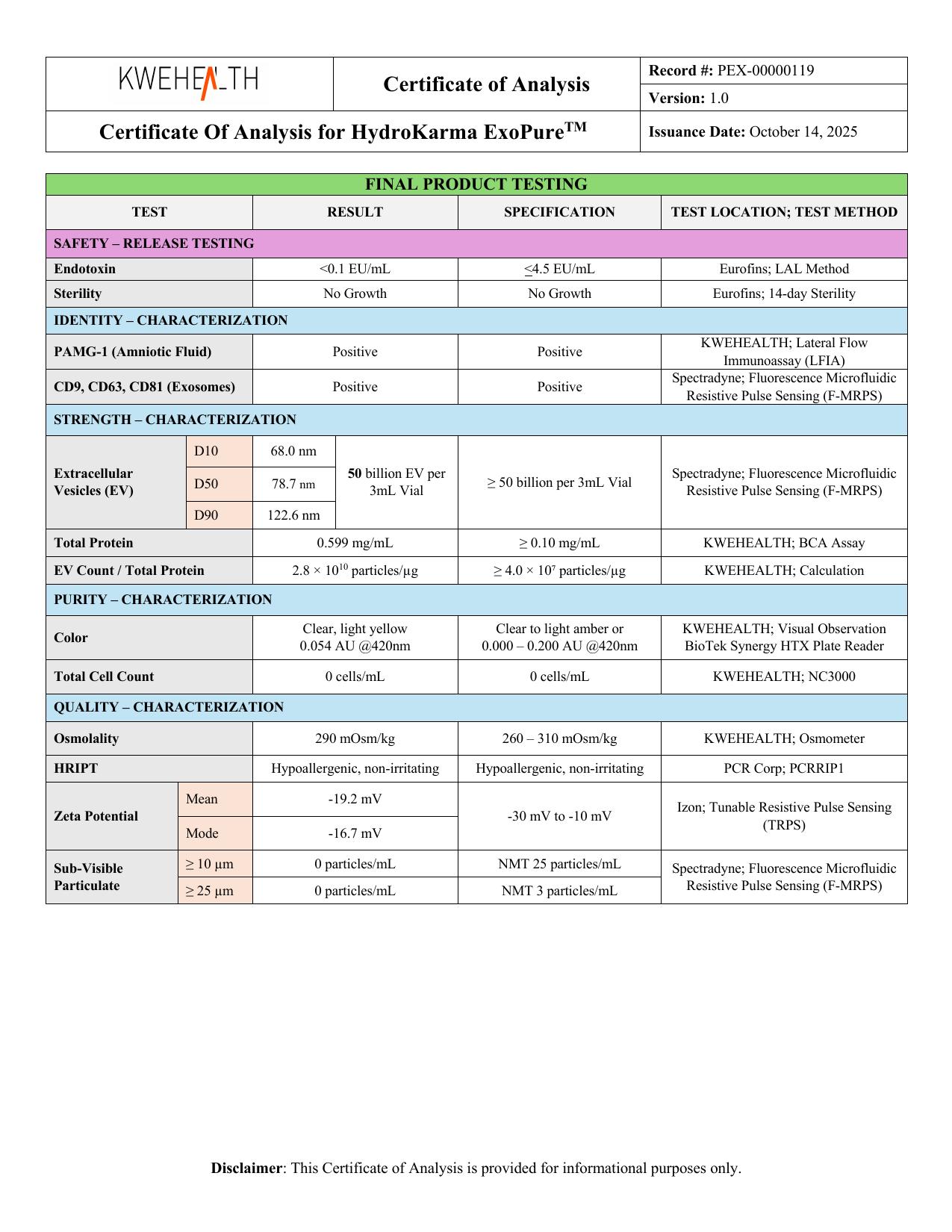
These are different tests answering different questions.
| Test | Reported Result | Basic Question |
|---|---|---|
| Sterility | No Growth | Was microbial growth detected under the test conditions? |
| Endotoxin | <0.1 EU/mL | What level of bacterial endotoxin was reported? |
The results should not be combined or substituted for one another.
Sterility Testing Is Not Endotoxin Testing
This distinction follows directly from the endotoxin article.
Sterility testing evaluates viable microbial contamination through growth-based or appropriately validated microbiological detection approaches.
Endotoxin testing evaluates bacterial endotoxin.
A sample could theoretically contain bacterial endotoxin without containing viable bacteria capable of growing in a sterility test.
Therefore:
No Growth ≠ zero endotoxin
and:
low endotoxin ≠ proof of sterility
For the full explanation, see What Is Endotoxin Testing and Why Does It Matter?.
How Does a Traditional Sterility Test Work?
At a high level, traditional compendial sterility testing involves exposing the tested sample to conditions capable of supporting microbial growth and observing whether evidence of growth develops.
The exact procedure depends on the product and test method.
USP <71> provides established sterility-test procedures, while FDA identifies USP <71> as a principal source for sterility-testing methods, procedures and media.
Two important approaches commonly associated with compendial sterility testing are:
membrane filtration
and:
direct inoculation/direct transfer.
What Is Membrane Filtration?
The concept is straightforward.
Instead of trying to grow microorganisms directly from the entire liquid volume, the liquid can be filtered through a membrane.
Potential microorganisms are retained by the membrane.
The membrane is then placed into or contacted with growth-supporting media.
The test is observed for evidence of microbial growth.
What Is Direct Inoculation?
Rather than filtering the sample first, the sample itself is introduced into the growth medium.
Which approach is appropriate depends on factors such as the product being tested and the applicable procedure.
We should therefore not assume which method KWEHEALTH used unless its documentation actually identifies it.
Why Are Different Culture Media Used?
Different microorganisms have different growth requirements.
Sterility testing therefore uses appropriate growth media and incubation conditions intended to support detection of a range of microorganisms.
The objective isn't simply to put a sample in one arbitrary liquid and wait.
The testing system needs to be capable of supporting microbial growth.
This is why sterility-testing controls include demonstrating that the media themselves can support growth.
FDA specifically discusses the importance of sterile, growth-promoting media and properly trained testing personnel.
What Is Growth Promotion Testing?
Imagine performing a sterility test with culture medium that is incapable of supporting microbial growth.
You might see:
No Growth
not because the sample was free from detectable viable contamination, but because the testing system couldn't grow microorganisms properly.
Growth-promotion controls help address that problem.
They evaluate whether the media are capable of supporting microbial growth under the defined conditions.
Can the Product Itself Interfere With Sterility Testing?
Yes.
This is an important analytical issue.
Some products or formulations can inhibit microbial growth.
If a product suppresses the microorganisms the test is supposed to detect, a misleading negative result could potentially occur.
That's why method suitability matters.
USP guidance on microbial recovery explains that even when a compendial method is established, its suitability for a particular product must be demonstrated because the product itself may interfere with microbial recovery.
Possible approaches for addressing interference can include appropriately validated:
- dilution
- membrane filtration
- rinsing
- neutralization
depending on the product and method.
That does not tell us which approach KWEHEALTH used.
It simply explains why product-specific test suitability matters.
Why Isn't Sterility Testing Perfect?
This is probably the most important concept in the article.
A sterility test evaluates samples.
It doesn't test every finished unit in a batch.
Destroying every vial to perform a sterility test would obviously leave no product to distribute.
Therefore, sampling is necessary.
And sampling creates a statistical limitation.
FDA's aseptic-processing guidance explicitly notes that sterility tests have limited ability to detect low-frequency contamination because of the relatively small number of units tested.
This means a passing sterility test should not be interpreted as if every single unit in a batch was individually proven sterile by direct testing.
Why Manufacturing Controls Matter So Much
If sterility testing has sampling limitations, how can manufacturers manage microbial contamination risk?
By not relying on the final sterility test alone.
A broader contamination-control strategy can involve:
- controlled manufacturing environments
- qualified personnel
- aseptic technique
- equipment controls
- environmental monitoring
- material controls
- validated processes
- cleaning and sanitization
- documentation
- microbiological testing
FDA describes the sterility test as one component of a broader control strategy rather than a substitute for well-controlled aseptic manufacturing.
This is why What Is Aseptic Processing? and sterility testing should be understood together.
Aseptic Processing vs. Sterility Testing
These concepts are closely related but not interchangeable.
Aseptic processing concerns how contamination is controlled while the product is being manufactured and handled.
Sterility testing evaluates samples for detectable viable microbial contamination under defined test conditions.
Think of it this way:
Aseptic processing asks: How are we controlling contamination during manufacturing?
Sterility testing asks: Was microbial growth detected in the tested samples?
A manufacturer shouldn't use a passing sterility test as a substitute for appropriate contamination controls.
Does Aseptic Processing Guarantee a Passing Sterility Test?
No.
Aseptic processing is designed to control contamination risk.
It doesn't mean contamination becomes physically impossible.
Likewise:
a passing sterility test doesn't prove the manufacturing process was flawless.
Process controls and final testing provide different kinds of information.
That distinction is part of the broader quality-system approach discussed in What Does cGMP Mean?.
What Happens if Growth Is Detected?
A sterility-test result showing microbial growth is significant.
But even then, the question isn't simply:
“Throw away the number and test again until it passes.”
An unexpected positive result requires investigation.
Potential questions can include:
- Was the organism introduced during manufacturing?
- Could contamination have occurred during laboratory testing?
- Were environmental or process excursions observed?
- Were testing controls acceptable?
- Is the organism identifiable?
- Are other batches or processes potentially affected?
FDA emphasizes investigation of sterility-test failures and cautions against casually attributing a positive result to laboratory error.
Why Can't You Just Keep Retesting?
Because repeated testing can create misleading confidence.
Suppose contamination is rare.
One test detects it.
A second sample doesn't.
That doesn't automatically prove the first result was wrong.
The underlying cause needs to be understood.
FDA has long emphasized that releasing a batch simply because a retest passes after an initial sterility failure can be difficult to justify without an appropriate investigation.
Sterility testing is therefore part of a quality system—not a game of repeatedly testing until the desired answer appears.
Is “No Growth” the Same as “Sterile Forever”?
No.
A sterility result describes testing associated with a particular sample, lot and point in time.
Maintaining microbiological quality also depends on factors such as:
- container integrity
- storage
- handling
- manufacturing controls
- product stability
FDA notes that maintaining sterility over a labeled shelf life depends in part on the integrity of the container-closure system.
So:
release sterility result ≠ unlimited future guarantee
Sterility Is Not Purity
Another important distinction:
sterility ≠ EV purity
A preparation could contain:
- proteins
- non-EV particles
- aggregates
- other nonmicrobial material
and still produce a sterility result of:
No Growth.
Sterility testing isn't designed to determine how selectively extracellular vesicles were isolated.
For that question, see What Is Extracellular Vesicle Purity?.
Sterility Is Not Particle Count
Likewise:
No Growth
doesn't tell us whether a vial contains:
1 billion particles
or:
100 billion particles.
Particle quantity requires particle-analysis methods.
For HydroKarma lot KH-0007DE, KWEHEALTH separately reports:
50 billion EV per 3 mL vial
using:
Spectradyne; Fluorescence Microfluidic Resistive Pulse Sensing (F-MRPS)
Those measurements answer an entirely different question from sterility testing.
See How Are Extracellular Vesicle Particle Counts Measured?.
Sterility Is Not Exosome Identity
Sterility testing also tells us nothing about whether particles are:
- extracellular vesicles
- exosomes
- another particle population
A sterility assay detects microbial growth.
It isn't an EV-identification assay.
Therefore:
No Growth ≠ proof of EV identity
and:
No Growth ≠ proof of exosome identity
How Should You Read “No Growth” on a COA?
When you see:
Sterility: No Growth
ask:
1. What sample and lot does this result describe?
Sterility results should be interpreted in their batch-specific context.
2. What method was used?
If the COA identifies a specific test method, read it.
If it doesn't, don't invent one.
3. Was growth detected?
“No Growth” means growth was not detected under the test conditions.
4. Is the result being overinterpreted?
It shouldn't be turned into an absolute claim beyond what the test establishes.
5. What other microbiological testing is reported?
Endotoxin, for example, answers a separate question.
6. What manufacturing controls surround the test?
Sterility testing is stronger when interpreted as part of an overall contamination-control strategy.
How This Fits Into the HydroKarma COA
By this point, we've examined a large portion of the Final Product Testing section of the KH-0007DE COA.
Each result answers its own question:
| Measurement | What It Helps Describe |
|---|---|
| EV Quantity | Particle quantity |
| D10/D50/D90 | Particle-size distribution |
| CD9/CD63/CD81 | Selected EV-associated markers |
| Total Protein | Bulk protein concentration |
| Particle-to-Protein Ratio | Relationship between particle and protein measurements |
| Zeta Potential | Electrokinetic characteristics |
| Cell Count | Detectable cells |
| Endotoxin | Bacterial endotoxin |
| Sterility | Detectable microbial growth |
| Osmolality | Dissolved-particle concentration behavior |
| Particulate Matter | Larger visible/subvisible particles within specified ranges |
No single row tells the whole story.
That's precisely why How to Read an Exosome Certificate of Analysis (COA) emphasizes interpreting the document as a collection of complementary measurements.
The Bottom Line
Sterility testing evaluates whether viable microbial growth is detected in tested samples under defined conditions.
For HydroKarma lot KH-0007DE, KWEHEALTH reports:
Sterility: No Growth
That result should be read exactly as reported.
It should not automatically be expanded into:
- zero microorganisms everywhere in the batch
- zero endotoxin
- permanent sterility
- EV purity
- EV identity
- exosome identity
- proof that every unit was individually tested
Sterility testing is valuable precisely because it provides one important piece of microbiological quality information.
But the strongest interpretation comes from combining that result with the broader manufacturing and testing picture.
The right question isn't:
“Does No Growth prove everything is sterile?”
It's:
The useful question
What did the sterility test evaluate, what result was reported, and how does that result fit into the overall contamination-control system?
Original Source / References
- United States Pharmacopeia — USP General Chapter <71>, Sterility Tests. USP <71> provides compendial sterility-testing procedures and is a principal reference for sterility testing. DOI: 10.31003/USPNF_M98810_01_01.
- FDA — Sterile Drug Products Produced by Aseptic Processing — Current Good Manufacturing Practice. FDA discusses sterility testing, microbiological laboratory controls, method suitability, sampling limitations and the relationship between finished-product testing and aseptic manufacturing controls.
- United States Pharmacopeia — USP General Chapter <1227>, Validation of Microbial Recovery from Pharmacopeial Articles. USP <1227> discusses method suitability and recovery of microorganisms in the presence of the tested product.
- KWEHEALTH/HydroKarma batch-specific Certificate of Analysis — Lot KH-0007DE. The HydroKarma-specific “Sterility: No Growth” result discussed in this article comes from manufacturer-supplied batch documentation and should not be attributed to USP or FDA. That documentation does not identify a specific sterility-test method.
Continue Learning
What Is Osmolality and Why Is It Measured?
A Certificate of Analysis may report “Osmolality: 290 mOsm/kg.” Here's what mOsm/kg means, how osmolality differs from osmolarity and tonicity, and why it isn't a particle count.
What Is Endotoxin Testing and Why Does It Matter?
A Certificate of Analysis may report “Endotoxin: <0.1 EU/mL.” Here's what Endotoxin Units mean, why endotoxin testing isn't sterility testing, and what a result like that does — and doesn't — establish.
What Is Aseptic Processing? A Beginner's Guide to Contamination Control
Aseptic processing uses controlled practices, environments, equipment, and procedures intended to prevent microbial contamination during manufacturing — which is not the same as a cleanroom classification, cGMP, or a sterility test result.
How to Read an Exosome Certificate of Analysis (COA)
A plain-English walkthrough of an extracellular-vesicle Certificate of Analysis: lot numbers, analytical methods, particle concentration, particle size, characterization, specifications and results.