
Product Education
How Do You Know if an Exosome Product Actually Contains Exosomes?
How buyers can tell whether an exosome product is supported by real evidence: particle count, size, EV markers, testing methods and batch-specific documentation considered together.
Listen to this article
A bottle can say “exosomes.”
A website can advertise “40 billion exosomes” with nothing to back it up.
But if you're considering buying the product, there's a more important question:
How do you know what's actually in the vial?
You don't need to become an extracellular-vesicle scientist to evaluate the evidence.
The simplest answer is to look for multiple pieces of characterization data that support one another, rather than trusting one impressive number or marketing claim.
Here's what that means.
Particle Count Is a Starting Point—not Proof
Many exosome products are advertised by particle count:
10 billion. 40 billion. 100 billion.
Measuring particles can tell you that nanoscale particles are present and provide information about how many were detected.
But there's an important limitation:
A particle count tells you how many particles were detected — not what each one is.
Some particle-measurement techniques can also detect non-EV material. MISEV2023 specifically recommends caution when interpreting particle concentration for this reason. If you want the technical detail, see how extracellular-vesicle particle counts are measured.
So a large number on a label, with no documentation behind it, isn't enough by itself.
What About Particle Size?
Size provides another clue.
Extracellular-vesicle preparations contain particles across a distribution of sizes, and manufacturers may report measurements such as D10, D50 and D90.
That gives you another piece of information about what's in the preparation.
But once again:
Size alone doesn't prove exosome identity.
Different types of extracellular particles can overlap in size. Even the measured diameter can vary depending on the analytical method used—our guide to extracellular vesicle size covers that in more depth.
Look for EV-Associated Markers
This is where names like CD9, CD63 and CD81 come in.
These proteins are commonly evaluated when characterizing extracellular vesicles.
Finding EV-associated proteins provides another type of evidence beyond simply counting particles.
But don't make the opposite mistake and assume:
CD9/CD63/CD81 positive = every particle is definitely an exosome.
There is no single universal molecular marker that identifies every EV or every EV subtype. Modern EV guidance therefore emphasizes combinations of characterization approaches rather than one “magic” marker.
If you want the deeper science behind these proteins, see our guide to CD9, CD63 and CD81 extracellular-vesicle markers.
Why Multiple Tests Matter
Think about it like identifying a car in a parking lot.
Someone tells you:
“There's a red object outside.”
That's information—but not enough to conclude it's a Ferrari.
Then you learn:
It has four wheels.
More evidence.
Then:
It has a Ferrari badge.
More evidence again.
Each observation strengthens the picture, but you'd still want to consider all of the evidence together.
EV characterization works on a similar principle.
Researchers may examine different characteristics such as:
quantity + size + proteins/markers + composition + other characteristics of the preparation.
MISEV2023 recommends complementary approaches because no single measurement answers every characterization question. Our overview of extracellular vesicle characterization and testing walks through those measurements individually.
Check the Certificate of Analysis
For a buyer, this is where things become practical. You shouldn't have to take the seller's word for it.
Ask to see the Certificate of Analysis or other batch-specific testing documentation, and check that it reports an identifiable lot, particle quantity and the method used to measure it, particle size, EV-associated characterization and actual results.
The goal isn't to become qualified to run the tests yourself. It's to see whether the company's claims are supported by documentation tied to the product you're buying.
For the full checklist, see What Should Be on an Exosome Certificate of Analysis?
What Does HydroKarma Report?
KWEHEALTH's batch-specific documentation for HydroKarma lot KH-0007DE provides a useful real-world example.
The manufacturer reports:
50 billion EV per 3 mL vial
along with particle-size measurements and positive results for CD9, CD63 and CD81, plus additional characterization and finished-product testing.
According to KWEHEALTH, HydroKarma's 50-billion designation means 50 billion exosomes per vial, in addition to other extracellular vesicles naturally present in the product.
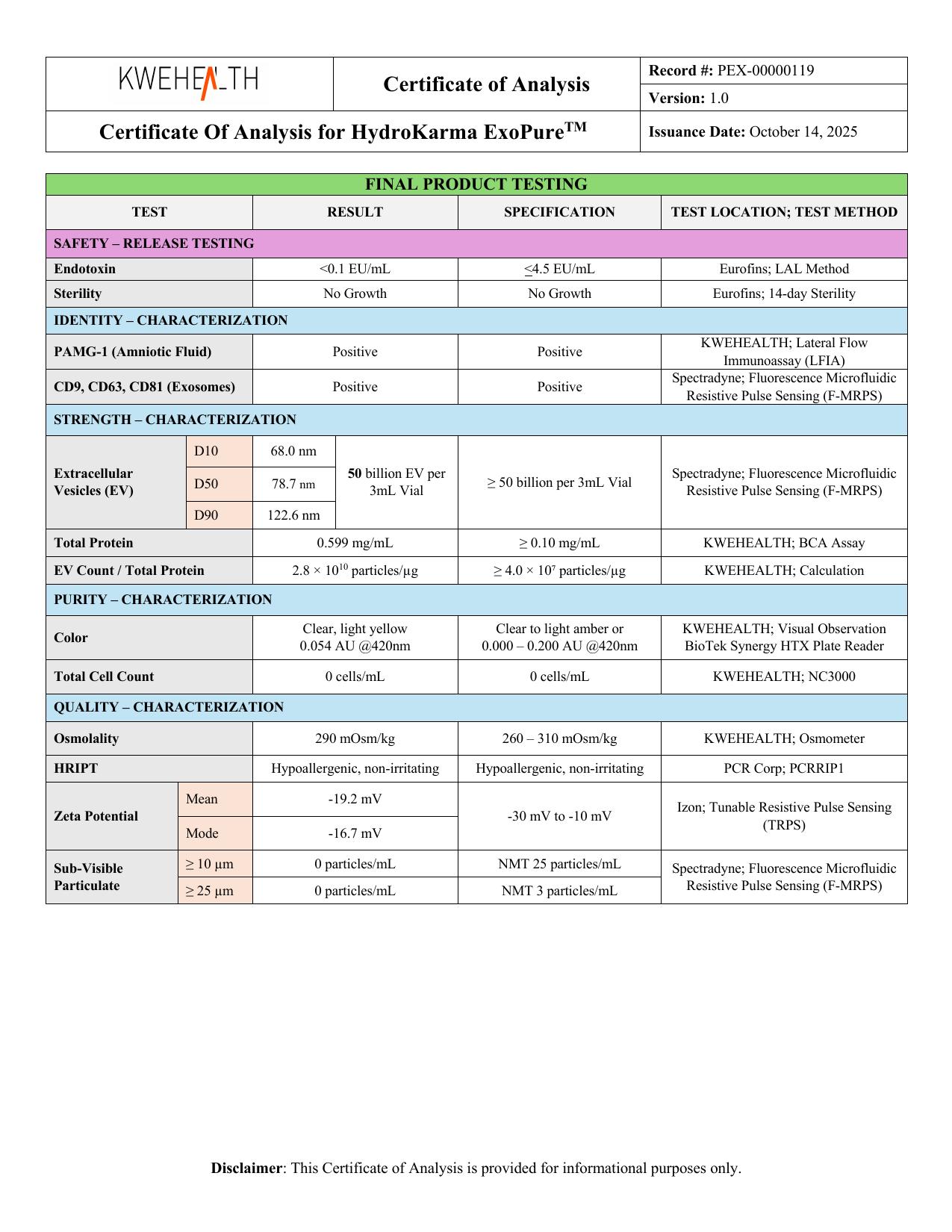
The reported particle quantity and size were measured using Spectradyne F-MRPS, according to KWEHEALTH's documentation.
Those results provide multiple pieces of information about that particular lot rather than relying only on a number printed on the front of a vial.
KWEHEALTH/HydroKarma states that extracellular vesicles carrying at least one of the tetraspanins CD9, CD63 or CD81 are included in its reported exosome count. That is the manufacturer's counting basis, not a universal scientific definition of an exosome.
Scientific guidance recommends care with the term “exosome” in general, because confirming that a vesicle formed through the endosomal pathway requires evidence beyond size or common EV-associated markers.
That's one reason you'll often see the broader scientific term extracellular vesicle (EV) used throughout our educational library.
So How Can You Tell?
As a buyer, you probably can't independently prove the identity of every nanoscale particle inside a vial.
That's not really the practical goal.
Instead, ask whether the manufacturer gives you multiple, meaningful pieces of evidence that can be evaluated together.
Each piece of evidence — particle quantity, size, EV-associated markers, transparent analytical methods and batch-specific documentation — is stronger when read together than any one of them alone.
The Bottom Line
Don't buy an exosome product simply because the label says “exosomes.”
And don't assume that 100 billion particles means 100 billion independently confirmed exosomes.
The question isn't:
“Does this company have one test that proves these are exosomes?”
A better question is:
“What evidence does this company provide to support what it says is in the vial?”
The more transparent and verifiable that answer is, the more informed your buying decision can be. Our broader checklist for evaluating an exosome product covers the rest.
Original Source / References
- Welsh JA, Goberdhan DCI, O'Driscoll L et al. — Minimal information for studies of extracellular vesicles (MISEV2023): From basic to advanced approaches. Journal of Extracellular Vesicles, 2024;13(2):e12404. DOI: 10.1002/jev2.12404 (PMID 38326288). MISEV2023 states that EV characterization is challenged by heterogeneity and a lack of universal identification methods, and recommends complementary approaches rather than reliance on a single measurement.
- KWEHEALTH/HydroKarma — manufacturer-supplied batch documentation for lot KH-0007DE. The manufacturer-specific values and analytical methods described above (50 billion EV per 3 mL vial, particle-size measurements, CD9/CD63/CD81 results, Spectradyne F-MRPS) come from that documentation, apply only to the documented lot, and are not findings of the independent publication above. MISEV2023 did not evaluate HydroKarma. These values do not establish safety, efficacy, regulatory approval or superiority over any other product.
Continue Learning
Planning on Buying Exosomes? Here’s What to Look for Before You Buy
What to look for before buying an exosome product — who manufactures it, where it comes from, what batch documentation supports it, how particle information is characterized, and how it is stored and shipped.
What Should Be on an Exosome Certificate of Analysis?
What buyers should look for on an exosome Certificate of Analysis: lot identification, particle quantity and size, EV markers, testing methods and actual results.
What Are CD9, CD63 and CD81? Understanding Common Extracellular Vesicle Markers
CD9, CD63 and CD81 are tetraspanin proteins commonly evaluated when characterizing extracellular vesicles. Their detection is a core part of how EV preparations are characterized, and KWEHEALTH/HydroKarma uses these three markers as the basis of its reported exosome count.
Understanding Extracellular Vesicle Characterization and Testing
Characterization is how laboratories measure and describe different properties of an extracellular-vesicle preparation — particle count, particle size, EV-associated markers, total protein and zeta potential — and why no single test describes everything.