
Product Education
What Should Be on an Exosome Certificate of Analysis?
What buyers should look for on an exosome Certificate of Analysis: lot identification, particle quantity and size, EV markers, testing methods and actual results.
Listen to this article
If you're considering buying an exosome product, one of the most important documents to examine is the Certificate of Analysis, commonly called a COA.
A comprehensive, batch-specific COA provides a detailed record of the testing and characterization performed on the product. It connects the vial to a specific production lot and gives buyers analytical information they can examine for themselves.
The quality of that documentation matters.
A strong COA should clearly identify the product and lot, show what was tested, describe the analytical methods used, and report meaningful results.
Here's what buyers should look for.
1. A Specific Lot or Batch Number
Start with something simple.
Which product was actually tested?
The COA should be tied directly to the product in your hand. The lot number on the COA should match the lot number on the product, confirming that the test results belong to that specific batch.
If the lot numbers don't match, the COA isn't documenting the product you received.
That's much more useful than being shown the same undated “sample COA” for every product.
2. Particle Quantity
Exosome and extracellular-vesicle products are frequently marketed using numbers such as:
10 billion. 40 billion. 100 billion.
If a company advertises a particle quantity, look for supporting analytical documentation.
One of the most important questions is:
How was that number measured?
HydroKarma's batch documentation answers that question directly. For example, the COA for lot KH-0007DE reports an EV quantity of 50 billion EV per 3 mL vial and identifies Spectradyne F-MRPS as the analytical method used for particle measurement.
According to KWEHEALTH, HydroKarma's 50-billion designation represents 50 billion exosomes per vial, with the reported exosome count based on extracellular vesicles carrying at least one of the three major tetraspanins: CD9, CD63 or CD81. Additional extracellular vesicles are also naturally present in the product.
For a deeper explanation of particle counts and how to compare them between products, see 50 Billion vs. 100 Billion Exosomes: Does a Higher Count Mean Better?
3. EV-Associated Markers
The CD9, CD63 and CD81 markers referenced in the particle-count section are also reported on HydroKarma's COA as part of its extracellular-vesicle characterization.
These proteins are commonly evaluated during extracellular-vesicle characterization. Our guide to CD9, CD63 and CD81 explains what these markers are and why they're measured.
Marker testing provides another documented piece of the product's characterization and works alongside the other analytical testing reported on the COA.
For a deeper look at these testing methods, see Extracellular Vesicle Characterization and Testing.
4. The Testing Method
This is one buyers often overlook.
A result is more useful when you know how it was obtained.
For example, if a COA reports billions of particles, what analytical technique generated that measurement?
If it reports total protein, what method was used?
A document containing only impressive numbers without explaining where they came from leaves important questions unanswered.
You don't need to become a laboratory scientist.
You simply want enough information to understand what was measured and how. Our technical walkthrough of how to read an exosome COA goes line by line if you want that level of detail.
5. Additional Finished-Product Testing
Depending on the product and manufacturer, a COA may contain additional information beyond EV characterization.
For example, KWEHEALTH's documentation for HydroKarma lot KH-0007DE reports results including:
- particle quantity and size
- CD9/CD63/CD81
- total protein
- particle-to-protein ratio
- cell count
- zeta potential
- endotoxin
- sterility
- osmolality
- particulate matter
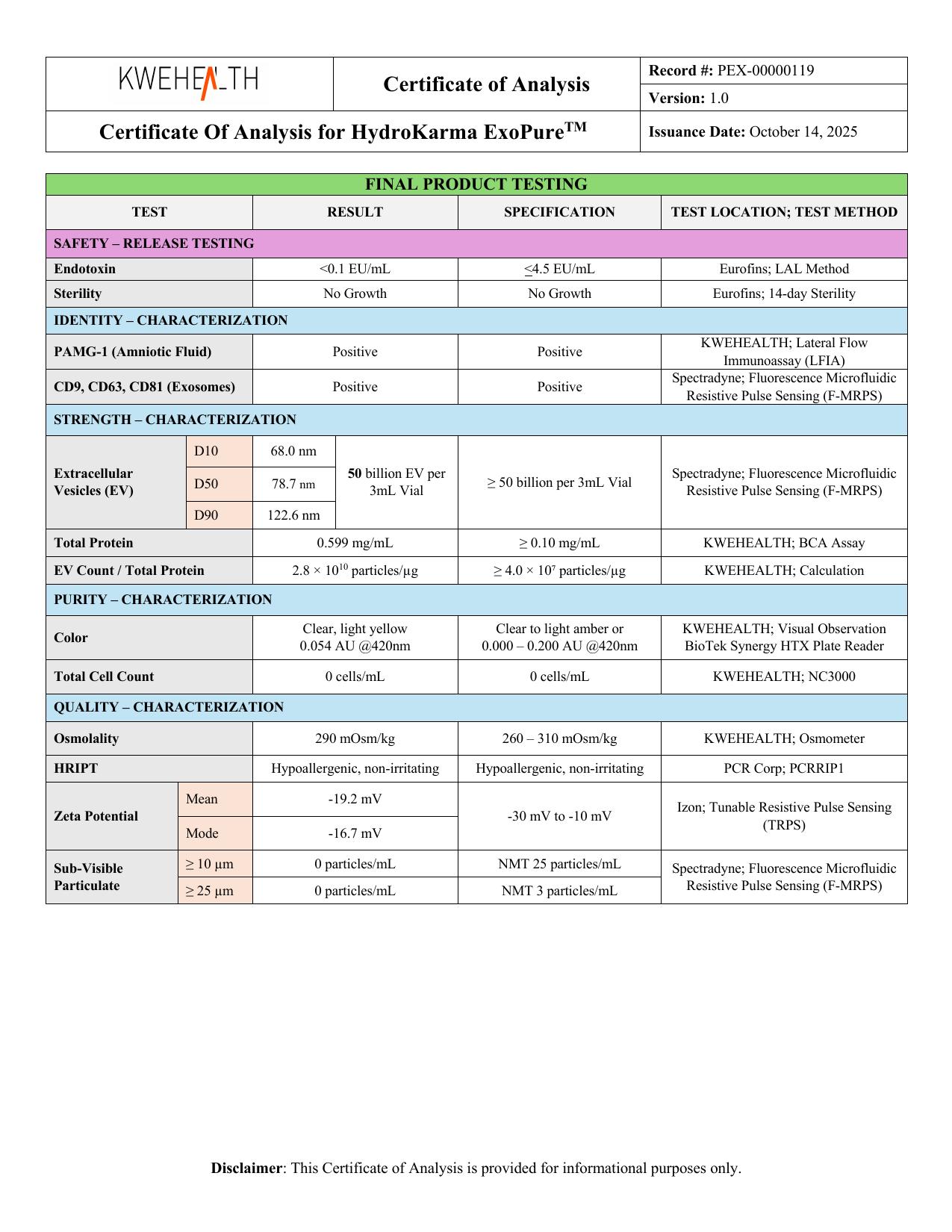
Those results are specific to that documented lot and shouldn't automatically be assumed to represent every past or future lot.
Different tests also answer different questions.
For example:
Sterility testing ≠ particle characterization.
Endotoxin testing ≠ EV identity.
Particle count ≠ purity.
6. Results—not Just Marketing Claims
Watch the difference between:
“Lab tested”
and
actual test results.
“Lab tested” sounds reassuring, but by itself it's extremely vague.
What was tested?
Which lot?
What method was used?
What was the result?
A useful COA should give you information you can actually examine rather than simply repeating marketing language.
What Does HydroKarma's COA Show?
HydroKarma's manufacturer, KWEHEALTH, provides batch-specific documentation containing multiple forms of characterization and finished-product testing.
For example, the documentation for lot KH-0007DE reports 50 billion EV per 3 mL vial, particle-size information, CD9/CD63/CD81 results and additional analytical testing.
Express Biologics makes this documentation available so buyers can examine the information themselves.
Taken together, this documentation provides a detailed, lot-specific analytical record of the finished product and gives buyers a meaningful way to verify important characteristics of what is in the vial.
The Bottom Line
A comprehensive Certificate of Analysis is an important part of a well-documented exosome or extracellular-vesicle product.
The COA connects the finished vial to a specific production lot and provides a record of the testing and characterization performed on that lot. Depending on the product and testing program, that may include particle quantity and size, EV-associated markers, protein measurements, sterility, endotoxin, osmolality and other finished-product specifications.
That documentation matters because buyers should not have to rely solely on a label or marketing claims to understand what they are purchasing. A robust, batch-specific COA provides analytical evidence that can be examined, compared with the product's specifications and traced back to the lot in the vial.
For HydroKarma, batch-specific COAs provide customers with detailed information about the characterization and finished-product testing performed on each documented lot.
When evaluating an exosome product, the COA shouldn't be treated as an afterthought. It is a key part of the documentation supporting the identity, characterization, testing and traceability of the finished product.
Original Source / References
- Welsh JA, Goberdhan DCI, O'Driscoll L et al. — Minimal information for studies of extracellular vesicles (MISEV2023): From basic to advanced approaches. Journal of Extracellular Vesicles, 2024;13(2):e12404. DOI: 10.1002/jev2.12404 (PMID 38326288). Cited for the general principles that EV preparations should be characterized using multiple complementary measurements, that a single particle number does not establish EV identity, and that the analytical method used affects how particle measurements should be interpreted.
- KWEHEALTH/HydroKarma — manufacturer-supplied batch documentation for lot KH-0007DE. All HydroKarma-specific values and tests referenced above come from that manufacturer-supplied documentation, apply only to the documented lot, and are not findings of the independent publication above.
Continue Learning
How Do You Know if an Exosome Product Actually Contains Exosomes?
How buyers can tell whether an exosome product is supported by real evidence: particle count, size, EV markers, testing methods and batch-specific documentation considered together.
How to Read an Exosome Certificate of Analysis (COA)
A plain-English walkthrough of an extracellular-vesicle Certificate of Analysis: lot numbers, analytical methods, particle concentration, particle size, characterization, specifications and results.
Planning on Buying Exosomes? Here’s What to Look for Before You Buy
What to look for before buying an exosome product — who manufactures it, where it comes from, what batch documentation supports it, how particle information is characterized, and how it is stored and shipped.