
Manufacturing & cGMP
What Is Extracellular Vesicle Yield and Recovery?
Yield describes how much extracellular-vesicle material is obtained. Recovery describes how much of a defined starting measurement is retained after processing. They are related, but not the same thing.
When evaluating an extracellular-vesicle preparation, two terms often appear in scientific discussions:
yield
and
recovery.
They sound like they mean the same thing.
Sometimes they're even used loosely or interchangeably.
But they can describe different concepts.
Yield generally describes how much material is obtained.
Recovery describes how much of the starting material—or a defined measurable component of it—is retained after a process.
That distinction becomes especially important when evaluating extracellular-vesicle isolation and purification.
A process that produces a large number of particles doesn't necessarily recover a large percentage of the EVs originally present.
And maximizing recovery doesn't automatically produce the purest preparation.
What Does EV Yield Mean?
Depending on the study, yield might be expressed as:
- particles per milliliter
- total particles
- particles per cell
- EV-associated protein
- marker abundance
- another defined measurement
That last point matters.
“High yield” means very little unless you know what was measured and what the result was normalized to.
For example:
5 × 10¹⁰ particles
is a total quantity.
But:
5 × 10¹⁰ particles per liter of starting material
provides additional context.
What Does EV Recovery Mean?
Recovery is often expressed as a percentage.
Conceptually:
Recovery (%) = amount recovered ÷ starting amount × 100
Imagine a starting sample in which an analytical method measures:
100 billion particles
After processing, the corresponding recovered fraction contains:
60 billion particles
Under that simplified example:
60 ÷ 100 × 100 = 60% recovery
But there's an important condition:
The before-and-after measurements need to be sufficiently comparable for that calculation to mean something.
Yield and Recovery Are Not the Same
Consider two hypothetical processes.
| Process | Starting Particles | Recovered Particles | Recovery |
|---|---|---|---|
| Process A | 100 billion | 60 billion | 60% |
| Process B | 1 trillion | 300 billion | 30% |
Hypothetical examples only
Process A and Process B are simplified educational illustrations. They do not represent real manufacturing processes, real HydroKarma data, or competing products.
Process B produces a much larger yield of particles:
300 billion vs. 60 billion
But Process A has the higher recovery percentage:
60% vs. 30%
So asking:
“Which process has the higher yield?”
is different from asking:
“Which process recovers a greater percentage of the starting material?”
Why Aren't All EVs Recovered?
Extracellular-vesicle processing involves physical separation.
During those steps, material can potentially be:
- retained by membranes
- left behind in discarded fractions
- adsorbed to surfaces
- lost during transfers
- excluded by collection windows
- removed along with unwanted material
- affected during concentration or storage
No separation method simply reaches into a biological fluid and retrieves every EV while leaving everything else behind.
That is one reason EV separation is technically challenging.
MISEV2023 discusses EV separation in terms of recovery and specificity, emphasizing that different methods involve different tradeoffs.
The Recovery-versus-Purity Tradeoff
Here's one of the most important concepts in EV processing:
Recovering more particles isn't automatically better.
Suppose a separation method collects a very broad fraction of material.
It may recover many EV-associated particles.
But it may also collect more:
- soluble proteins
- lipoproteins
- non-vesicular extracellular particles
- other components from the starting material
Now imagine narrowing the collection criteria.
You might remove more unwanted material—but lose some EVs too.
The result could be:
lower recovery
but:
greater separation from non-vesicular material.
This is the basic recovery-versus-specificity tradeoff described in modern EV guidance.
A Real Example of the Tradeoff
Research using size-exclusion chromatography provides a good illustration.
Researchers have found that changing which chromatography fractions are collected can change both EV recovery and sample purity.
One study comparing different SEC configurations found that collecting narrower fractions could increase separation from proteins while decreasing EV recovery.
Another study combining ultrafiltration and SEC similarly found that reducing the collected fraction window decreased particle recovery while improving measures of sample purity.
That doesn't mean one result is automatically better.
The appropriate balance depends on the purpose of the preparation.
Why 100% Recovery Isn't Necessarily the Goal
At first, 100% recovery sounds ideal.
Why wouldn't you want every particle?
Because the purpose of EV isolation isn't necessarily to recover every nanoscale object in the starting material.
The goal may instead involve separating EV-associated material from other components.
If a method maximizes particle recovery by collecting almost everything, the resulting preparation could also contain substantial non-EV material.
Therefore:
maximum recovery ≠ maximum purity
and:
maximum particle yield ≠ optimal EV preparation
That's why our article What Is Extracellular Vesicle Purity? treats purity as a separate question.
How Can EV Yield Be Measured?
There isn't one universal measurement called “EV yield.”
Researchers may evaluate yield using different analytical approaches.
For example:
Particle measurements
A particle-analysis method may report particle concentration or total particle quantity.
EV-associated markers
Researchers may examine recovery of proteins such as CD9, CD63 or CD81.
Protein measurements
Total or selected protein measurements may contribute additional information.
Other molecular measurements
Depending on the study, researchers may evaluate other EV-associated components.
The important question is:
What exactly is being used as the measure of yield?
Two studies can both report “EV yield” while using different definitions and analytical methods.
Why Particle Yield Isn't Automatically EV Yield
This distinction should sound familiar from our earlier articles.
A particle-counting instrument detects particles according to the capabilities and limitations of the method.
It does not necessarily establish the biological identity of every detected particle.
Therefore:
particle yield ≠ automatically confirmed EV yield
If a paper reports yield using particle counts, the accurate interpretation is that the reported yield is based on the particle measurement used in that study.
Other characterization evidence helps establish what the preparation contains.
See Understanding Extracellular Vesicle Characterization and Testing for the broader picture.
Why the Starting Material Matters
A yield number without starting-material context can be difficult to interpret.
Imagine two researchers both recover:
50 billion particles
Researcher A started with:
10 mL
Researcher B started with:
1 liter
Those are very different processing outcomes.
Useful normalization can therefore include measures such as:
- starting fluid volume
- number of cells
- tissue mass
- processing batch
- original particle measurement
The appropriate denominator depends on the experimental system.
Why the Measurement Method Matters
Recovery calculations depend on measurements made before and after processing.
If the analytical method changes, interpretation becomes more difficult.
Particle-analysis techniques have different:
- detection limits
- sensitivities
- size ranges
- measurement principles
The same issue applies to protein or marker measurements.
Therefore, a recovery percentage isn't simply a property of the separation equipment.
It is also dependent on how recovery was measured.
Isolation Method Can Affect Recovery
Different EV-separation methods can produce different yields and recovery rates.
For example, research comparing ultrafiltration followed by size-exclusion liquid chromatography with differential ultracentrifugation found a higher EV yield with the ultrafiltration/chromatography approach in the preparations studied.
Other research has demonstrated that SEC column configuration, fraction selection and ultrafiltration choices can alter EV recovery.
These findings don't establish one universally superior EV-isolation method.
They demonstrate something more useful:
Processing choices can change what is ultimately recovered.
That's why What Is Extracellular Vesicle Isolation and Purification? discusses the strengths and limitations of different separation approaches.
Storage Can Affect Recovery Too
Recovery isn't only relevant during initial separation.
EV-associated measurements can also change during:
- concentration
- transfer
- freezing
- thawing
- storage
For example, a study by van de Wakker, Görgens and colleagues evaluated how buffer composition, concentration methods, storage containers and other conditions influenced EV recovery and preservation. The researchers found that several of those variables affected measured EV recovery in the preparations they studied.
That doesn't mean every EV preparation behaves identically.
It demonstrates why recovery must be evaluated under defined conditions.
For more on storage, see What Is Cold-Chain Storage and Why Does It Matter?.
What Does the HydroKarma COA Tell Us?
KWEHEALTH's batch-specific Certificate of Analysis for HydroKarma lot KH-0007DE reports:
EV quantity: 50 billion EV per 3 mL vial
with particle quantity and size associated with:
Spectradyne; Fluorescence Microfluidic Resistive Pulse Sensing (F-MRPS).
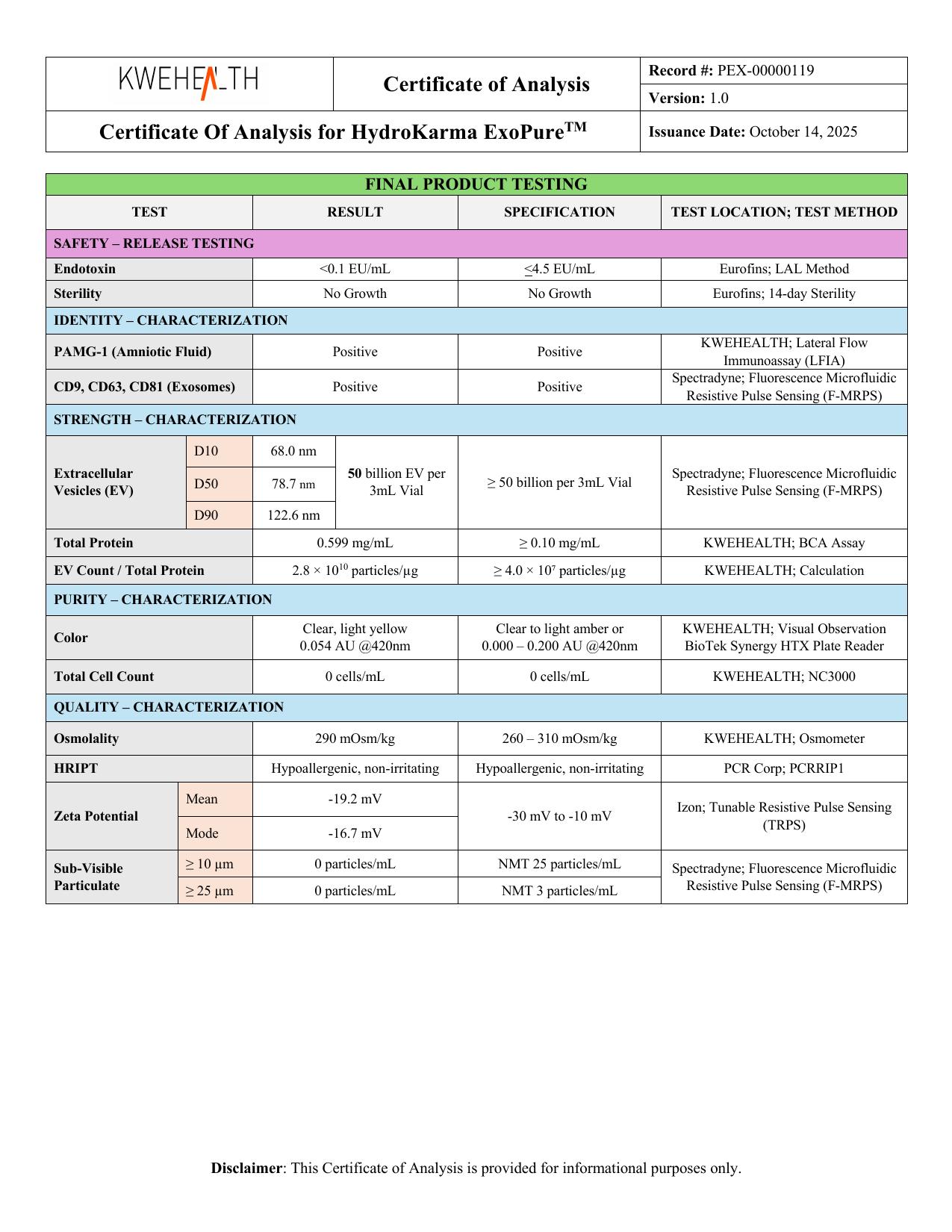
That is a finished-product quantity measurement.
It tells us what KWEHEALTH reports for the tested final lot.
It does not, by itself, tell us the manufacturing recovery percentage.
To calculate recovery, we would need appropriate information about the relevant starting amount and the amount recovered after the defined processing step, measured on a sufficiently comparable basis.
The supplied COA does not provide that complete calculation.
Therefore, we should not claim:
“HydroKarma has a 90% EV recovery rate.”
or:
“KWEHEALTH recovers X% of the EVs from the starting amniotic fluid.”
We don't have the evidence to calculate that.
Why Can't We Calculate Recovery From 50 Billion EV?
Because:
50 billion EV per vial is an endpoint quantity.
Recovery requires a starting reference.
Suppose someone tells you:
I finished with 80 apples.
You still can't calculate what percentage of the original apples were recovered unless you know how many apples you started with.
If the starting quantity were 100:
80% recovery
If it were 160:
50% recovery
Same final yield.
Different recovery.
That's why a finished-vial particle quantity doesn't establish manufacturing recovery efficiency.
What About KWEHEALTH's Purification Process?
According to information supplied by KWEHEALTH/HydroKarma, clinical-grade amniotic fluid is obtained through authorized tissue acquisition under defined donor criteria, quarantined while communicable-disease testing is completed, and then processed, purified, characterized and vialed.
That tells us the broad manufacturing sequence.
It does not disclose enough information to calculate the EV recovery efficiency of KWEHEALTH's proprietary purification process.
We shouldn't attempt to infer it.
The distinction is the same one we've maintained in How Are Exosomes Produced and Processed?:
We can accurately describe what KWEHEALTH has supplied about its process without inventing proprietary details that haven't been provided.
Yield Is Not Purity
A preparation can have:
high yield + lower separation from non-vesicular material
or:
lower yield + greater separation from some non-vesicular components.
Those aren't the only possible outcomes, but they illustrate why yield and purity are separate concepts.
Therefore:
high yield ≠ high purity
and:
low yield ≠ high purity
Neither can be inferred from the other.
Recovery Is Not Product Quality
Recovery efficiency is also not a universal measure of product quality.
A higher recovery percentage might be desirable in a manufacturing process because losing less target material can improve efficiency.
But recovery alone doesn't tell you:
- what else was recovered
- particle identity
- purity
- sterility
- particle size
- marker profile
- biological activity
- product safety
- product effectiveness
A recovery percentage is useful only for the question it actually answers.
How Should You Read EV Yield or Recovery Claims?
When you encounter an EV yield or recovery number, ask:
1. What is being measured?
Particles? Markers? Protein? Another signal?
2. What is the starting reference?
Volume? Cell number? Starting particle measurement?
3. What analytical method was used?
Measurement technology affects the result.
4. Is this yield or recovery?
A final quantity and a percentage retained from starting material are not necessarily the same thing.
5. What happened to purity or specificity?
Higher recovery can sometimes come with greater co-isolation of other material.
6. Are the comparison conditions equivalent?
Different starting materials and analytical methods can make direct comparisons misleading.
7. Is someone turning process efficiency into a product-quality claim?
Recovery alone doesn't establish overall quality.
The Bigger Picture
Yield and recovery matter because every EV-processing workflow involves choices.
Researchers and manufacturers may need to balance:
- recovery
- specificity
- purity
- processing time
- scalability
- reproducibility
and other practical considerations.
MISEV2023's recovery/specificity framework reflects this reality: EV separation isn't simply about finding the method that produces the biggest number.
The goal is to understand what was recovered, how it was measured, what else may have been recovered with it, and whether the resulting preparation is appropriate for its intended analytical purpose.
The Bottom Line
Extracellular-vesicle yield and recovery are related concepts, but they aren't identical.
Yield describes how much material is obtained according to a defined measurement.
Recovery describes how much of a defined starting measurement is retained after processing.
A process can produce a large final yield while still having a relatively low recovery percentage if the starting amount was much larger.
And maximizing recovery doesn't automatically maximize purity.
For HydroKarma lot KH-0007DE, KWEHEALTH reports:
50 billion EV per 3 mL vial.
That's useful finished-product characterization.
But it does not tell us what percentage of EV-associated material was recovered from the original amniotic fluid.
Without appropriate starting measurements and processing data, that recovery percentage cannot responsibly be calculated.
That's the central lesson:
The central lesson
Don't ask only how much EV-associated material was obtained. Ask how yield was defined, what the process started with, how recovery was measured, and what tradeoffs accompanied it.
Original Source / References
- Welsh et al. — Minimal information for studies of extracellular vesicles (MISEV2023): From basic to advanced approaches. Journal of Extracellular Vesicles, 2024. DOI: 10.1002/jev2.12404, PMID: 38326288. MISEV2023 discusses the recovery/specificity tradeoffs associated with EV separation and provides current guidance for interpreting EV production, separation and characterization.
- Nordin et al. — Ultrafiltration with size-exclusion liquid chromatography for high yield isolation of extracellular vesicles preserving intact biophysical and functional properties. Nanomedicine: Nanotechnology, Biology and Medicine, 2015. DOI: 10.1016/j.nano.2015.01.003, PMID: 25659648. The researchers compared UF-LC with differential ultracentrifugation and reported higher EV yield with UF-LC in the preparations studied.
- van de Wakker et al. (with Görgens among the co-authors) — Influence of short term storage conditions, concentration methods and excipients on extracellular vesicle recovery and function. European Journal of Pharmaceutics and Biopharmaceutics, 2022. DOI: 10.1016/j.ejpb.2021.11.012, PMID: 34864197. The study examined how several processing and storage variables affected measured EV recovery and preservation in the preparations studied.
- KWEHEALTH/HydroKarma batch-specific Certificate of Analysis — Lot KH-0007DE. The HydroKarma-specific finished-product quantity and F-MRPS information discussed above comes from manufacturer-supplied documentation. No HydroKarma manufacturing recovery percentage is stated or inferred.
Continue Learning
What Is Extracellular Vesicle Concentration vs. Total Particle Count?
Particle concentration tells you how many measured particles are present per unit volume. Total particle count tells you how many are associated with the entire defined volume. They're related — but not the same.
What Is Extracellular Vesicle Isolation and Purification?
A plain-English guide to the processes used to separate and enrich extracellular vesicles from complex biological material, the tradeoffs each approach involves, and why characterization is a separate question from processing.
What Is Extracellular Vesicle Purity? How EV Purity Is Evaluated
Extracellular vesicle purity is a multidimensional characterization question, not a single number on a Certificate of Analysis. Here's how particle counts, protein measurements, markers and particle-to-protein ratios each contribute — and what none of them establish alone.
Understanding Extracellular Vesicle Characterization and Testing
Characterization is how laboratories measure and describe different properties of an extracellular-vesicle preparation — particle count, particle size, EV-associated markers, total protein and zeta potential — and why no single test describes everything.