
Quality, Testing & COAs
What Is Extracellular Vesicle Protein Content and Why Is It Measured?
Total protein tells you how much protein was measured in a preparation — not how many extracellular vesicles are present. Here's what protein results and particles/µg ratios do and don't mean.
When reading an extracellular-vesicle Certificate of Analysis, you may encounter a result such as:
Total protein: 0.599 mg/mL
At first glance, that number can be confusing.
Does it tell you how many extracellular vesicles are present?
Does more protein mean a better EV preparation?
Does protein represent contamination?
And why might a Certificate of Analysis report both particle quantity and total protein?
The key is understanding that these measurements answer different questions.
Particle count tells us about detected particles.
Total protein tells us how much protein was measured in the preparation under the conditions of the assay.
Neither measurement should automatically be substituted for the other.
Why Do Extracellular Vesicles Contain Proteins?
Extracellular vesicles are membrane-enclosed particles released by cells.
Their membranes and internal contents can contain proteins, along with lipids, nucleic acids and other molecules.
Some proteins may be associated with EV membranes.
Others may be present within vesicles.
And depending on the preparation, proteins can also exist outside EVs or remain associated with other components of the sample.
This distinction is important because a total protein measurement does not tell us that every measured protein molecule came from inside an extracellular vesicle.
Total protein is therefore a measurement of the preparation as tested—not a direct count of extracellular vesicles.
Why Measure Total Protein?
Protein measurement can contribute useful information during EV characterization and processing.
Researchers may use it to help:
- characterize an EV preparation
- compare processing fractions
- evaluate protein enrichment or depletion
- monitor consistency
- calculate particle-to-protein relationships
- provide context alongside other analytical measurements
MISEV2023 discusses total protein quantification as one component of EV characterization while emphasizing its limitations.
The important point is that protein measurements become more informative when interpreted alongside other data.
How Is Total Protein Measured?
Several methods can be used to estimate total protein.
MISEV2023 identifies approaches including colorimetric assays, fluorometric assays, protein staining and absorbance-based measurements.
One commonly used method is the BCA assay.
BCA stands for bicinchoninic acid.
In simplified terms, the assay produces a color response related to protein concentration. That response is compared with a reference curve to estimate the amount of protein in the tested sample.
Like any analytical method, the result depends on the assay conditions and appropriate measurement procedures.
A Real HydroKarma Example
KWEHEALTH's batch-specific Certificate of Analysis for HydroKarma lot KH-0007DE reports:
| Test | Reported Result | Method |
|---|---|---|
| Total Protein | 0.599 mg/mL | BCA |
| EV Count / Total Protein | 2.8 × 10¹⁰ particles/µg | Calculated from reported measurements |
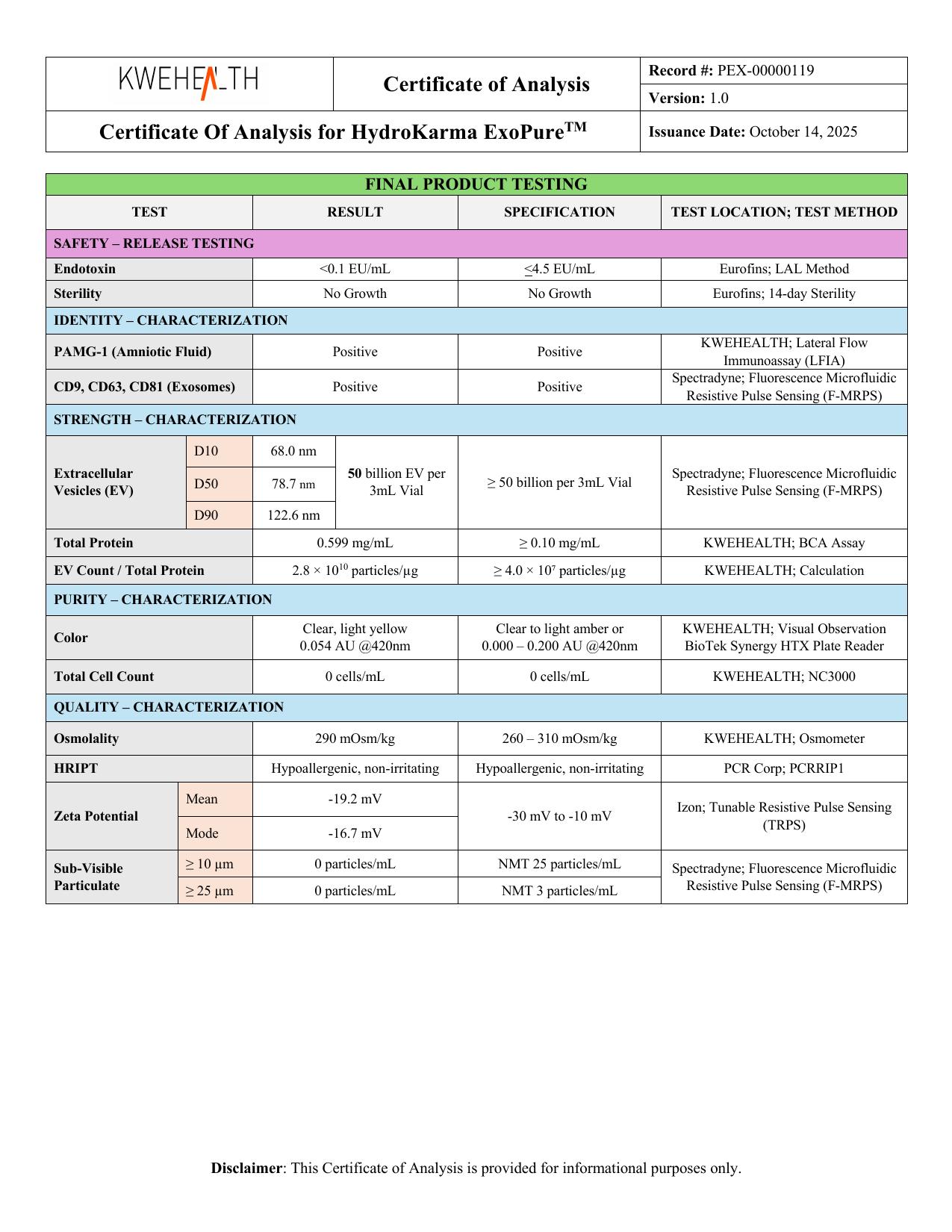
These are manufacturer-reported, lot-specific results.
The COA separately reports:
EV quantity: 50 billion EV per 3 mL vial
and particle-size measurements of:
- D10: 68.0 nm
- D50: 78.7 nm
- D90: 122.6 nm
This is a good example of why a COA contains multiple measurements.
The particle measurement and protein measurement describe different characteristics of the preparation.
What Does 0.599 mg/mL Mean?
The reported:
0.599 mg/mL
is a protein concentration.
It means KWEHEALTH reports that the BCA assay measured a total protein concentration of 0.599 milligrams per milliliter for this lot.
Because:
1 mg = 1,000 µg
the same concentration could also be expressed as:
599 µg/mL
But that does not mean there are 599 µg/mL of “exosome protein.”
The BCA assay measures total protein detectable under the conditions of the assay.
It doesn't independently establish where every measured protein molecule is located.
Is Total Protein the Same as EV Concentration?
No.
This distinction is particularly important.
MISEV2023 cautions against using protein concentration as a substitute for extracellular-vesicle concentration because the amount of protein associated with EV preparations can vary and non-vesicular proteins may also be present.
Therefore:
total protein ≠ particle count
and:
total protein ≠ EV concentration
If you want to know how particle quantity is measured and reported, see Understanding Exosome Concentration and Particle Count.
Does More Protein Mean More Extracellular Vesicles?
Not necessarily.
Imagine two preparations:
Sample A
- High particle count
- Moderate total protein
Sample B
- Lower particle count
- Higher total protein
You couldn't conclude that Sample B contains more EVs simply because it contains more protein.
The protein could potentially come from:
- EV-associated proteins
- proteins within EVs
- soluble proteins
- protein complexes
- other protein-containing material
The exact composition depends on the sample and how it was processed.
That's one reason particle count and protein concentration are measured separately.
Does Protein Mean Contamination?
No—not automatically.
This is another easy mistake to make.
Extracellular vesicles themselves contain proteins.
Therefore, some protein in an EV preparation is expected.
At the same time, biological starting materials can contain abundant non-vesicular proteins, and some of those proteins may remain after separation and purification.
So the correct interpretation isn't:
protein = contamination
It's:
Total protein measures protein in the preparation, and additional characterization is needed to understand what that measurement represents.
Our article What Is Extracellular Vesicle Purity? explores that distinction in more detail.
What Is a Particle-to-Protein Ratio?
One way researchers have attempted to put particle quantity and protein concentration into context is by calculating a particle-to-protein ratio.
Webber and Clayton proposed comparing nanoparticle counts with protein concentration as a practical way to assess EV preparations.
Conceptually, the calculation asks:
How many measured particles are present relative to the measured amount of protein?
For example:
particles ÷ µg of protein
may produce a result expressed as:
particles/µg
The HydroKarma Particle-to-Protein Result
For KH-0007DE, KWEHEALTH reports:
EV Count / Total Protein: 2.8 × 10¹⁰ particles/µg
That equals:
28 billion particles per microgram
as reported on the batch COA.
This measurement combines information from two underlying measurements:
particle quantity
and
total protein
But the ratio shouldn't replace those original measurements.
MISEV2023 specifically recommends providing the absolute protein and particle measurements when ratios are reported because the ratio can depend on the analytical methods and their detection limits.
That is exactly why looking at the complete COA is more informative than looking only at:
2.8 × 10¹⁰ particles/µg
Is Particles/µg a Purity Score?
Not in the simple sense of:
higher number = automatically purer product.
Historically, particle-to-protein ratios have been proposed as one way of estimating EV-preparation purity. Webber and Clayton's 2013 paper is an important example.
But modern interpretation requires more caution.
The ratio can be affected by:
- particle-measurement method
- particle detection limits
- protein-assay method
- assay sensitivity
- EV source
- separation method
- co-isolated particles
- non-vesicular proteins
- sample preparation
MISEV2023 therefore recommends reporting the underlying measurements rather than relying on the ratio alone.
So:
particle-to-protein ratio ≠ universal purity score
A ratio can contribute characterization information without being treated as a definitive grade of product quality.
Why the Measurement Method Matters
For KH-0007DE, the COA reports different analytical approaches for different measurements.
Particle quantity and size: Spectradyne; Fluorescence Microfluidic Resistive Pulse Sensing (F-MRPS)
Total protein: BCA
These methods measure fundamentally different things.
F-MRPS provides particle-related information.
BCA provides bulk protein information.
The reported particle-to-protein relationship combines results derived from those different measurements.
That makes the underlying methods part of the interpretation.
Why You Shouldn't Compare Ratios Blindly
Suppose two EV products report:
Product A: 3 × 10¹⁰ particles/µg
Product B: 1 × 10¹⁰ particles/µg
It may be tempting to conclude:
Product A is three times purer.
That conclusion isn't justified from the ratios alone.
Before making a meaningful comparison, you would want to know whether the products were measured using comparable:
- particle-counting technologies
- detection limits
- protein assays
- sample preparation
- reporting conventions
Different analytical methods can produce different underlying measurements.
A ratio derived from those measurements inherits those methodological differences.
Protein Content and EV Markers Are Different
Total protein measurement also shouldn't be confused with EV-associated protein-marker testing.
For example, KWEHEALTH reports for KH-0007DE:
- CD9: Positive
- CD63: Positive
- CD81: Positive
Those results tell us that selected EV-associated proteins were detected.
The BCA result:
0.599 mg/mL
answers a different question—it reports total protein concentration.
Therefore:
total protein ≠ marker identity
For more on those marker results, see What Are CD9, CD63 and CD81?.
Protein Measurement and Purification
Protein measurement can also be useful when evaluating EV isolation and purification processes.
If a separation process changes the amount of measured protein relative to measured particles or selected EV-associated markers, those changes may provide information about enrichment and recovery.
MISEV2023 recommends tracking relevant measurements through separation and concentration processes where appropriate.
But again, no single measurement tells the whole story.
Our guide What Is Extracellular Vesicle Isolation and Purification? explains why different processing approaches can affect the resulting preparation.
How Should You Read Protein Results on a COA?
When a COA reports protein measurements, ask:
1. What exactly is being reported?
Total protein? A specific protein? A marker result? A particle-to-protein ratio?
2. What units are used?
For example, mg/mL, µg/mL or particles/µg.
3. What analytical method was used?
For KH-0007DE, KWEHEALTH reports BCA for total protein.
4. Are the original particle and protein measurements available?
A ratio is easier to interpret when its components are also reported.
5. Is someone treating total protein as particle concentration?
Those are different measurements.
6. Is someone treating all protein as contamination?
That's also an oversimplification.
7. Is a particle-to-protein ratio being presented as a universal purity score?
Be cautious.
This is why How to Read an Exosome Certificate of Analysis (COA) emphasizes evaluating results together.
The Bigger Picture
Protein content is one part of EV characterization.
Consider some of the measurements we've examined from KH-0007DE:
| Measurement | What It Helps Describe |
|---|---|
| Particle quantity | Number of reported particles |
| D10/D50/D90 | Particle-size distribution |
| CD9/CD63/CD81 | Selected EV-associated markers |
| Total protein | Bulk protein concentration |
| Particles/µg | Relationship between particle and protein measurements |
| Zeta potential | Electrokinetic behavior under test conditions |
Each contributes different information.
None should automatically be treated as a substitute for all the others.
The Bottom Line
Extracellular-vesicle preparations contain proteins, but total protein measurement isn't the same thing as counting extracellular vesicles.
For HydroKarma lot KH-0007DE, KWEHEALTH reports:
Total protein: 0.599 mg/mL
using a:
BCA assay
and reports:
EV Count / Total Protein: 2.8 × 10¹⁰ particles/µg
Those measurements provide useful characterization information for that particular lot.
But they don't mean:
- all measured protein is contamination
- all measured protein necessarily belongs to EVs
- protein concentration equals EV concentration
- a particle-to-protein ratio is a universal purity score
- a higher ratio automatically means a superior product
The best approach is to interpret protein measurements alongside particle quantity, size, markers, purification information and other characterization data.
Total protein tells us something useful about an EV preparation—but it doesn't tell us everything about it.
Original Source / References
- Welsh et al. — Minimal information for studies of extracellular vesicles (MISEV2023): From basic to advanced approaches. Journal of Extracellular Vesicles, 2024. DOI: 10.1002/jev2.12404, PMID: 38326288. MISEV2023 discusses total protein quantification, its limitations, protein/particle ratios, assay considerations and reporting recommendations for EV characterization.
- Webber & Clayton — How pure are your vesicles? Journal of Extracellular Vesicles, 2013. DOI: 10.3402/jev.v2i0.19861, PMID: 24009896. Webber and Clayton proposed comparing nanoparticle counts with protein concentration as a practical method for estimating vesicle-preparation purity.
- KWEHEALTH/HydroKarma batch-specific Certificate of Analysis — Lot KH-0007DE. The HydroKarma-specific protein concentration, BCA method and EV-count/total-protein result discussed in this article come from manufacturer-supplied batch documentation. They are not findings of the independent scientific papers above.
Continue Learning
What Is the Particle-to-Protein Ratio in Extracellular Vesicles?
A particle-to-protein ratio compares measured particles with measured protein. Here's how particles/µg is calculated, why it depends on the methods behind it, and why it isn't a purity percentage.
What Is Extracellular Vesicle Purity? How EV Purity Is Evaluated
Extracellular vesicle purity is a multidimensional characterization question, not a single number on a Certificate of Analysis. Here's how particle counts, protein measurements, markers and particle-to-protein ratios each contribute — and what none of them establish alone.
Understanding Exosome Concentration and Particle Count
A particle count can provide useful information about a sample, but the number needs context: how it was measured, the volume it represents, the size distribution, and what else may be present.
How to Read an Exosome Certificate of Analysis (COA)
A plain-English walkthrough of an extracellular-vesicle Certificate of Analysis: lot numbers, analytical methods, particle concentration, particle size, characterization, specifications and results.