
Exosomes & Extracellular Vesicles
What Is Extracellular Vesicle Concentration vs. Total Particle Count?
Particle concentration tells you how many measured particles are present per unit volume. Total particle count tells you how many are associated with the entire defined volume. They're related — but not the same.
When an extracellular-vesicle product says:
50 billion EV
that sounds straightforward.
But another document might report:
1.0 × 10¹⁰ particles/mL
Are those the same thing?
Not exactly.
One describes a total particle quantity.
The other describes a particle concentration.
Understanding the difference is important because the same preparation can have one concentration but very different total particle counts depending on the volume being considered.
What Is Particle Concentration?
Particle concentration is commonly reported as:
particles/mL
which means:
particles per milliliter
MISEV2023 describes particle number concentration as EV or particle number combined with a volume measurement, commonly expressed in particles per milliliter.
For example:
10 billion particles/mL
means that the measured concentration is:
10 billion particles in each milliliter of the sample, assuming the preparation is adequately mixed and the measurement represents that sample.
What Is Total Particle Count?
For example, suppose a vial contains:
3 mL
and has a particle concentration of:
10 billion particles/mL
Then the total quantity would be:
10 billion particles/mL × 3 mL = 30 billion particles
So:
Concentration = particles per unit volume
while:
Total count = particles in the entire defined volume
A Simple Example
Imagine two vials containing the same preparation.
| Vial | Concentration | Volume | Total Particle Count |
|---|---|---|---|
| A | 10 billion particles/mL | 1 mL | 10 billion particles |
| B | 10 billion particles/mL | 4 mL | 40 billion particles |
Hypothetical examples only
Vial A and Vial B are simplified educational illustrations. They do not represent real products, real HydroKarma lots, or competing products.
The concentration is identical.
But Vial B contains four times the total particle quantity because it contains four times the volume.
This is why you cannot compare two products intelligently by looking at particle concentration alone or total count alone without also checking the volume.
Why Does the Volume Matter?
Suppose Product A reports:
20 billion particles
and Product B reports:
10 billion particles/mL
Which contains more particles?
You don't know yet.
Product A gives you a total quantity.
Product B gives you a concentration.
To determine Product B's total quantity, you need its total volume.
If Product B contains:
1 mL
then it contains:
10 billion particles total.
If it contains:
4 mL
then it contains:
40 billion particles total.
Same concentration.
Very different total quantity.
A Real HydroKarma Example
KWEHEALTH's batch-specific Certificate of Analysis for HydroKarma lot KH-0007DE reports:
EV Quantity: 50 billion EV per 3 mL vial
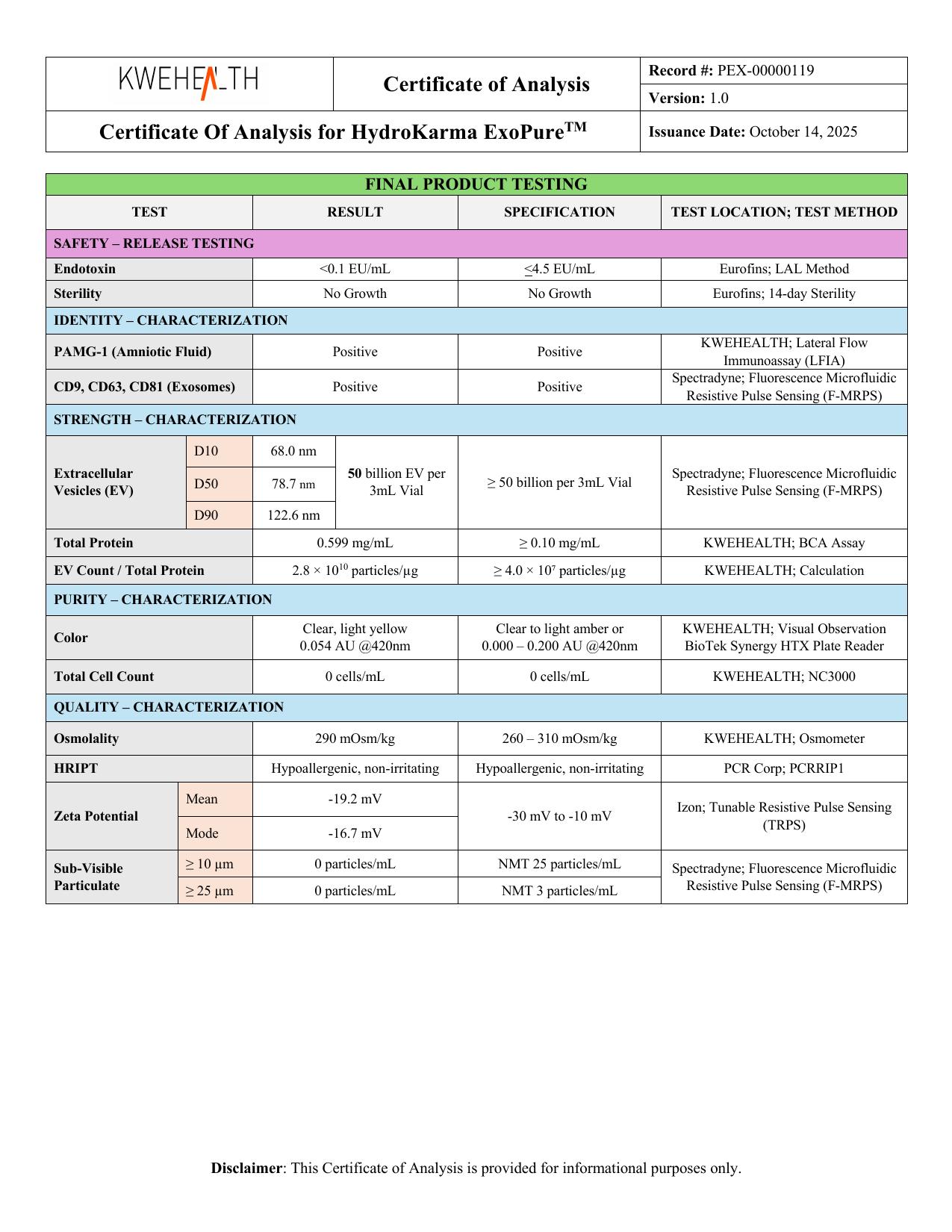
That is a total quantity associated with the vial volume.
The COA reports an EV quantity of 50 billion EV per 3 mL vial. According to KWEHEALTH, HydroKarma's 50-billion designation means 50 billion exosomes per vial, in addition to other extracellular vesicles naturally present in the product.
So the COA is communicating the finished-vial quantity directly rather than requiring the reader to calculate it from a separately reported concentration.
The reported particle quantity/size method is:
Spectradyne; Fluorescence Microfluidic Resistive Pulse Sensing (F-MRPS).
These are manufacturer-reported, lot-specific results.
Measured Values vs. Calculated Values
Because scientific documentation should distinguish:
measured values
from:
calculated values
If a laboratory directly measures and reports:
10 billion particles/mL
that's a reported concentration result.
If a document instead reports:
40 billion particles in 4 mL
and we divide one by the other, we've created a useful calculated concentration.
The math can be completely valid while the source of the number is different.
This is the same principle we use throughout the Learn library:
Say what the document reports, then clearly label what we calculate from it.
Why Are Particle Concentrations Used?
Particle concentration is useful because it normalizes particle number to volume.
That makes it easier to:
- compare sample concentrations
- prepare analytical inputs
- dilute samples
- standardize experimental conditions
- understand how densely particles are present within a suspension
MISEV2023 notes that particle number concentration is widely reported for purposes including assay input standardization and measurement reporting.
But concentration remains only one characterization measurement.
Is Particle Concentration the Same as EV Concentration?
Not necessarily.
This is a subtle but important wording issue.
A particle-counting method may detect particles according to the capabilities of the technology.
Many particle-analysis techniques do not independently prove that every counted particle is an extracellular vesicle.
MISEV2023 specifically cautions that particle-number concentration can be unreliable because many techniques lack complete specificity for EVs and may not detect all EVs equally.
Therefore:
particle concentration ≠ guaranteed EV concentration
unless the method provides sufficient evidence to establish the identity of the particles being counted.
Why Does the Measurement Method Matter?
Particle-number measurements depend on analytical technology.
Common approaches can include:
- nanoparticle tracking analysis
- resistive pulse sensing
- flow cytometry in applicable particle ranges
- other single-particle measurement technologies
These systems detect particles according to different physical principles.
For example, nanoparticle tracking analysis commonly uses particle motion and light-scattering behavior to estimate size and concentration.
Vestad and colleagues showed that NTA measurements of EV size and concentration can vary with instrument settings and sample characteristics.
Van der Pol and colleagues also showed that different EV measurement technologies can produce different size-distribution and concentration results.
This means:
10 billion particles/mL measured by one method should not automatically be assumed equivalent to 10 billion particles/mL measured by another method.
Why Dilution Matters
Particle-counting instruments often work best within a particular concentration range.
If a sample is too concentrated, particles may interfere with accurate detection.
If it's too dilute, too few particles may be detected for reliable analysis.
Researchers may therefore dilute samples before measurement.
The instrument result can then be adjusted using the dilution factor to estimate the concentration of the original sample.
For example:
Measured diluted sample:
2 × 10⁸ particles/mL
Dilution factor:
100
Calculated original concentration:
2 × 10¹⁰ particles/mL
Hypothetical calculation
This dilution example is a hypothetical educational calculation. It is not HydroKarma data and does not describe any KWEHEALTH measurement.
That calculation is useful—but again, the analytical method and dilution procedure are part of the result.
Total Count Can Be More Intuitive for a Finished Vial
For a finished product, total particle quantity can sometimes be easier for a customer to understand.
Compare:
10 billion particles/mL
with:
40 billion particles per 4 mL vial
The first describes concentration.
The second tells the reader directly what quantity the manufacturer reports for the full vial.
Neither is inherently better.
They simply answer different questions.
Concentration asks: How many particles are present per unit volume?
Total count asks: How many particles are associated with the entire specified volume?
Concentration Can Change Without Changing Total Particle Count
Imagine a sample containing:
40 billion particles total
in:
4 mL
Its concentration is:
10 billion particles/mL
Now imagine the sample is concentrated down to:
1 mL
while retaining the same 40 billion measured particles.
The new concentration becomes:
40 billion particles/mL
The concentration increased fourfold.
But the total particle count stayed:
40 billion particles.
This illustrates why concentration and total quantity shouldn't be treated as interchangeable.
Total Count Can Change While Concentration Stays the Same
The reverse can happen too.
Suppose:
10 billion particles/mL
is maintained while the sample volume increases from:
1 mL
to:
10 mL
The concentration remains:
10 billion particles/mL
but the total particle quantity becomes:
100 billion particles.
Again:
same concentration
different total quantity
Concentration Is Not Purity
A very concentrated preparation isn't necessarily a very pure preparation.
A sample could contain:
100 billion detected particles/mL
while also containing substantial non-EV material.
Another preparation could contain fewer particles per milliliter but be more selectively enriched for EV-associated material.
Therefore:
high particle concentration ≠ high EV purity
For that topic, see What Is Extracellular Vesicle Purity?.
Concentration Is Not Yield or Recovery
Particle concentration also shouldn't be confused with yield or recovery.
As discussed in What Is Extracellular Vesicle Yield and Recovery?:
Yield describes how much material is obtained.
Recovery describes how much of a defined starting measurement is retained.
Concentration describes how densely particles are present within a volume.
A sample can become more concentrated without increasing total yield.
That's exactly why these terms need to remain separate.
Concentration Is Not Exosome Identity
The same principle applies to biological identity.
A preparation reporting:
20 billion particles/mL
doesn't automatically contain:
20 billion confirmed exosomes/mL.
Particle-number measurements need to be interpreted alongside:
- size data
- EV-associated markers
- morphology or other characterization
- purification information
- analytical method
- other supporting evidence
That's why Understanding Extracellular Vesicle Characterization and Testing emphasizes complementary measurements.
How Should You Compare Two EV Products?
When comparing particle quantities, don't look only at the biggest number.
Ask:
1. Is the number concentration or total quantity?
Look for units.
2. What is the product volume?
You need volume to understand total quantity from concentration.
3. What analytical method was used?
Methodology affects particle measurements.
4. Is the number directly measured or calculated?
Know where the figure came from.
5. Are you comparing equivalent measurements?
Particles/mL and particles/vial aren't directly comparable without conversion.
6. Does the measurement establish particle identity?
Don't assume every detected particle is automatically an exosome.
7. What does the rest of the characterization show?
Particle count is only one piece.
How Does This Appear on a COA?
When reading a Certificate of Analysis, look carefully at both:
the number
and:
the units
These units can completely change what a number means.
For example:
5 × 10¹⁰ particles
means a total quantity.
5 × 10¹⁰ particles/mL
means a concentration.
Those are dramatically different statements.
That's why How to Read an Exosome Certificate of Analysis (COA) emphasizes reading the entire result—not just the number.
The Bigger Picture
Particle concentration and total particle count are closely related.
The relationship is:
Total particle count = particle concentration × volume
and:
Particle concentration = total particle count ÷ volume
But each describes the preparation differently.
For a scientific experiment, concentration may be particularly useful for standardizing inputs.
For a finished vial, total quantity may be more intuitive for communicating how many particles are reported in the complete product volume.
The important thing is knowing which one you're looking at.
The Bottom Line
Extracellular-vesicle concentration and total particle count are not the same measurement, even though they're mathematically related.
Particle concentration tells you how many measured particles are present per unit volume.
Total particle count tells you how many measured particles are associated with the entire defined volume.
For HydroKarma lot KH-0007DE, KWEHEALTH reports:
50 billion EV per 3 mL vial
using particle analysis identified as:
Spectradyne; Fluorescence Microfluidic Resistive Pulse Sensing (F-MRPS).
According to KWEHEALTH, that 50-billion designation refers to exosomes per vial, in addition to other extracellular vesicles naturally present in the product.
And most importantly:
A bigger particle number isn't automatically a better product.
Always ask:
Always ask
Is this concentration or total count? What volume does it describe? How was it measured? And what does the rest of the characterization tell us?
Original Source / References
- Welsh et al. — Minimal information for studies of extracellular vesicles (MISEV2023): From basic to advanced approaches. Journal of Extracellular Vesicles, 2024. DOI: 10.1002/jev2.12404, PMID: 38326288. MISEV2023 discusses particle-number concentration, normalization by volume, analytical limitations, and the importance of understanding method specificity and sensitivity.
- Vestad et al. — Size and concentration analyses of extracellular vesicles by nanoparticle tracking analysis: a variation study. Journal of Extracellular Vesicles, 2017. DOI: 10.1080/20013078.2017.1344087, PMID: 28804597. This study examined variability in NTA-based EV size and concentration measurements and found that instrument and measurement conditions can materially influence results.
- van der Pol et al. — Particle size distribution of exosomes and microvesicles determined by transmission electron microscopy, flow cytometry, nanoparticle tracking analysis, and resistive pulse sensing. Journal of Thrombosis and Haemostasis, 2014. DOI: 10.1111/jth.12602, PMID: 24818656. This study supports the point that EV concentration and size measurements can differ across analytical technologies.
- KWEHEALTH/HydroKarma batch-specific Certificate of Analysis — Lot KH-0007DE. HydroKarma-specific particle quantity, vial volume and F-MRPS information are derived from manufacturer-supplied batch documentation.
Continue Learning
How Are Extracellular Vesicle Particle Counts Measured?
A Certificate of Analysis can report billions of particles — but how does a laboratory arrive at that number? A plain-English guide to RPS, MRPS, NTA, flow cytometry and why the method behind a particle count matters.
Understanding Exosome Concentration and Particle Count
A particle count can provide useful information about a sample, but the number needs context: how it was measured, the volume it represents, the size distribution, and what else may be present.
What Is Extracellular Vesicle Yield and Recovery?
Yield describes how much extracellular-vesicle material is obtained. Recovery describes how much of a defined starting measurement is retained after processing. They are related, but not the same thing.
Understanding Extracellular Vesicle Characterization and Testing
Characterization is how laboratories measure and describe different properties of an extracellular-vesicle preparation — particle count, particle size, EV-associated markers, total protein and zeta potential — and why no single test describes everything.