
Quality, Testing & COAs
What Is Osmolality and Why Is It Measured?
A Certificate of Analysis may report “Osmolality: 290 mOsm/kg.” Here's what mOsm/kg means, how osmolality differs from osmolarity and tonicity, and why it isn't a particle count.
A Certificate of Analysis may contain a result that looks very different from particle count, sterility or endotoxin:
Osmolality: 290 mOsm/kg
What exactly does that number mean?
Osmolality is fundamentally a measurement related to the concentration of dissolved particles in a solution.
It does not measure extracellular-vesicle quantity.
It does not tell us whether particles are exosomes.
And it is not another way of reporting purity.
Instead, osmolality provides information about the solution surrounding the particles.
For HydroKarma lot KH-0007DE, KWEHEALTH's batch-specific Certificate of Analysis reports:
Osmolality: 290 mOsm/kg
Understanding what that measurement represents makes another section of the COA much easier to interpret.
What Is Osmolality?
For many aqueous pharmaceutical and laboratory preparations, the number is commonly reported as:
mOsm/kg
which means:
milliosmoles per kilogram
USP <785> and <1785> address osmolality and osmolarity measurement and practical considerations surrounding these measurements.
What Does mOsm/kg Mean?
The abbreviation can be broken apart:
mOsm = milliosmoles
kg = kilogram of solvent
So:
290 mOsm/kg
describes the measured osmolality of the solution.
It does not mean:
- 290 particles per kilogram
- 290 extracellular vesicles
- 290 mg of material
- 290 molecules
- 290 mOsm per vial
Osmolality concerns the collective contribution of dissolved species to the solution's osmotic behavior.
Osmolality Is About Dissolved Particles
Suppose salt dissolves in water.
The dissolved species contribute to the solution's osmolality.
Other dissolved substances can contribute as well.
The measurement is therefore concerned with the effective concentration of osmotically active dissolved particles.
This is very different from the particle-count measurements we've discussed elsewhere in the Learn library.
For example:
EV particle analysis → nanoscale particles
while:
osmolality → dissolved-particle concentration behavior of the solution
Those are not interchangeable measurements.
Osmolality vs. Osmolarity
These two words look almost identical, which makes them easy to confuse.
The distinction is:
Osmolality → based on mass of solvent
Osmolarity → based on volume of solution
FDA materials similarly distinguish osmolality as a solute-concentration measurement expressed relative to solvent weight and osmolarity relative to volume.
In dilute aqueous solutions, the numerical values may sometimes be relatively close.
But scientifically, the terms aren't identical and shouldn't be used interchangeably without justification.
Why Is Osmolality Measured?
Osmolality is useful because the dissolved composition of a formulation affects its physical and osmotic properties.
In pharmaceutical development and quality testing, osmolality or osmolarity may be monitored when those properties are relevant to the formulation or product specification.
FDA guidance, for example, identifies osmolarity/osmolality as an attribute that may require appropriate control depending on the formulation and intended specification.
For our purposes, the important point is simpler:
Osmolality provides information about the solution environment.
It does not directly characterize EV identity.
A Real HydroKarma Example
KWEHEALTH's batch-specific Certificate of Analysis for HydroKarma lot KH-0007DE reports:
Osmolality: 290 mOsm/kg
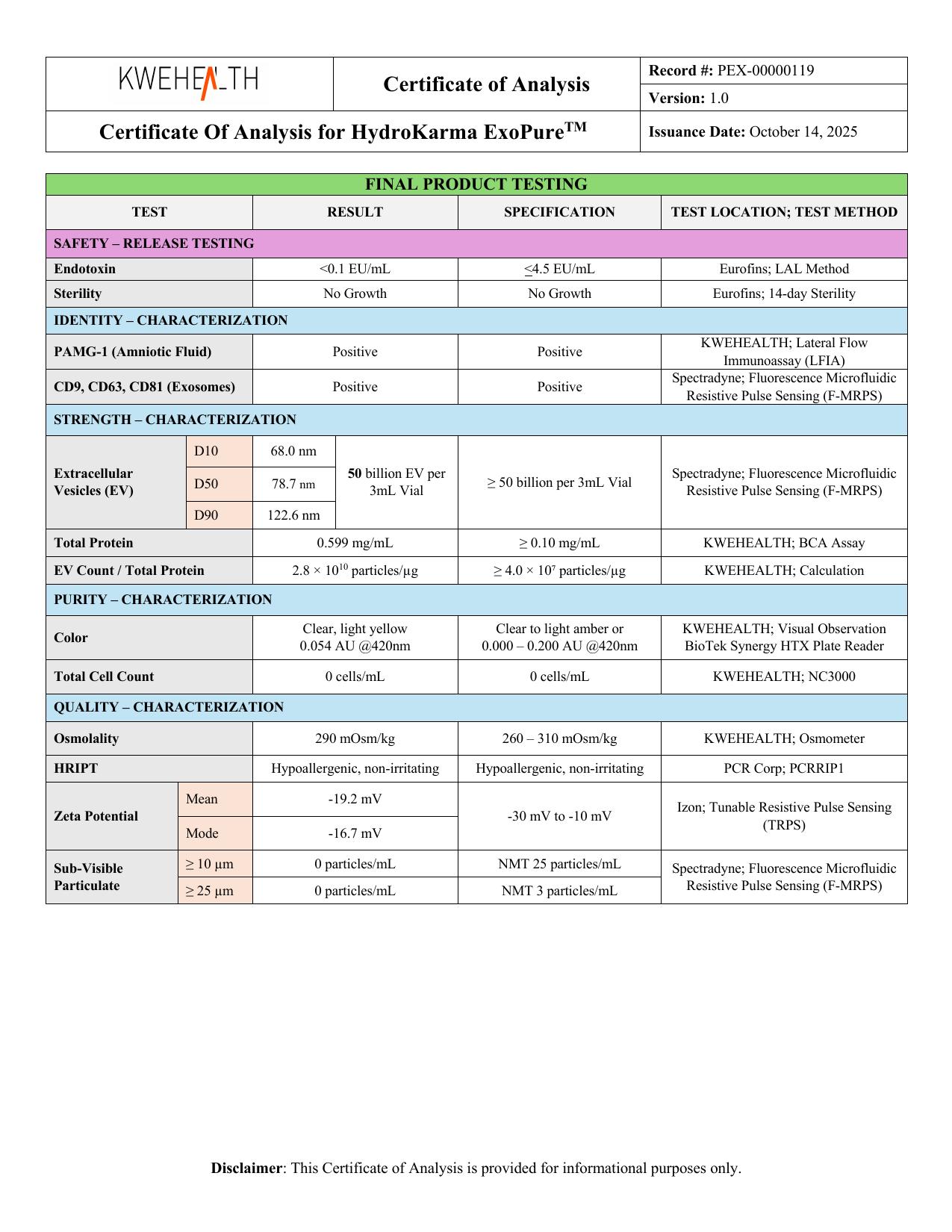
That is a manufacturer-reported, lot-specific result.
It should be reproduced exactly as:
290 mOsm/kg
unless additional manufacturer documentation provides further context.
We should not convert that number into a different measurement or assign it a biological meaning the COA doesn't establish.
Does 290 mOsm/kg Tell Us the Number of EVs?
No.
The same HydroKarma COA separately reports:
EV Quantity: 50 billion EV per 3 mL vial
Those are completely different measurements.
| Measurement | Reported Result | What It Describes |
|---|---|---|
| EV Quantity | 50 billion EV per 3 mL vial | Reported particle quantity |
| Osmolality | 290 mOsm/kg | Osmotic concentration of the solution |
The osmolality number cannot be used to calculate EV quantity.
Likewise, the EV quantity cannot be used to calculate osmolality.
Osmolality Is Not Particle Concentration
This distinction is especially important because both measurements involve the word concentration.
Particle concentration may be expressed as:
particles/mL
Osmolality may be expressed as:
mOsm/kg
But they describe completely different things.
Particle concentration asks:
How many detectable particles are associated with a defined volume?
Osmolality asks:
What is the concentration of osmotically active dissolved species relative to the mass of solvent?
For more on particle concentration, see What Is Extracellular Vesicle Concentration vs. Total Particle Count?.
How Is Osmolality Measured?
Osmolality can be determined using physical properties of a solution that change according to dissolved-particle concentration.
One commonly used approach is:
freezing-point osmometry.
USP <785> discusses freezing-point osmometry, while USP <1785> provides additional practical considerations for determining whether an osmolality instrument and procedure are suitable for particular formulations.
What Is Freezing-Point Osmometry?
Adding dissolved particles to a solvent changes certain physical properties.
One of those is the freezing point.
In simplified terms:
more dissolved osmotically active particles → greater freezing-point depression
An osmometer can measure that change and use it to determine the sample's osmolality.
Why Does Dissolved Material Lower the Freezing Point?
Pure water has a characteristic freezing point under defined conditions.
When substances dissolve in the water, the organization of water molecules into the solid ice structure is affected.
As a result, the solution freezes at a lower temperature than the pure solvent.
The magnitude of this freezing-point depression is related to the number of dissolved particles.
This is known as a colligative property.
Other classic colligative properties include changes in vapor pressure and boiling point.
For osmolality testing, freezing-point depression provides a practical way to estimate osmotic concentration.
Is Freezing-Point Osmometry HydroKarma's Reported Method?
We should not assume that.
The KH-0007DE COA reports:
Osmolality: 290 mOsm/kg
But unless the authentic COA or other KWEHEALTH documentation identifies the analytical method, we should not state that HydroKarma's result was obtained by freezing-point osmometry.
Freezing-point osmometry is discussed here because it is a recognized general method for osmolality measurement.
That is different from saying:
“KWEHEALTH used freezing-point osmometry.”
If the manufacturer documentation doesn't tell us the method, the correct answer is:
We don't know from the supplied documentation.
What About Vapor-Pressure Osmometry?
Another analytical approach can use changes in vapor pressure associated with dissolved substances.
USP practical guidance discusses considerations surrounding different types of osmolality instruments and measurement behavior.
Again, this is general education.
We should not assign a vapor-pressure method—or any other specific method—to the HydroKarma result unless KWEHEALTH's documentation actually identifies it.
Osmolality Is Not Tonicity
This is another distinction worth understanding.
People sometimes use osmolality and tonicity as though they mean exactly the same thing.
They don't.
Osmolality measures the concentration of osmotically active particles in a solution.
Tonicity depends on how particular solutes behave across a biological membrane.
USP <1785> specifically discusses the relationship and distinction between tonicity and osmolality.
Therefore:
osmolality ≠ automatically tonicity
and:
same osmolality ≠ necessarily identical biological behavior
Why Does Membrane Permeability Matter for Tonicity?
Imagine two solutions with similar measured osmolality.
One contains solutes that remain largely outside a cell.
Another contains solutes capable of crossing the cell membrane.
Those solutions may affect cellular water movement differently even though their measured osmolality is similar.
That's why tonicity is not determined solely by reading an osmolality number.
Osmolality is a physical measurement.
Tonicity involves a biological membrane response.
Does 290 mOsm/kg Mean “Isotonic”?
We should not automatically make that claim from the COA value alone.
It may be tempting to compare 290 mOsm/kg with commonly cited physiological values and simply label the preparation “isotonic.”
But that goes beyond what the reported osmolality measurement alone establishes.
Tonicity depends on the nature and membrane permeability of the dissolved substances, not merely the numerical osmolality.
Therefore, the safest interpretation is:
What we can say
KWEHEALTH reports an osmolality of 290 mOsm/kg for lot KH-0007DE.
We don't need to turn that into an unsupported physiological claim.
Osmolality Is Not pH
Another common confusion involves pH.
Both pH and osmolality describe aspects of a solution, but they measure different properties.
pH describes acidity or alkalinity through hydrogen-ion activity.
Osmolality describes osmotic concentration.
A solution can have the same pH as another solution while having a very different osmolality.
Likewise, two solutions can have similar osmolality but different pH values.
Therefore:
pH ≠ osmolality
Osmolality Is Not Purity
A result of:
290 mOsm/kg
doesn't tell us whether an EV preparation is highly purified.
The dissolved formulation components themselves contribute to osmolality.
So osmolality is not a purity score.
For EV purity, see What Is Extracellular Vesicle Purity?.
Osmolality Is Not Sterility
Osmolality also tells us nothing about whether viable microorganisms were detected.
For KH-0007DE, the COA separately reports:
Sterility: No Growth
The osmolality measurement does not produce that result.
Likewise, sterility testing doesn't determine osmolality.
See What Is Sterility Testing? Understanding “No Growth” on a COA.
Osmolality Is Not Endotoxin
The same distinction applies to endotoxin.
KWEHEALTH reports:
Endotoxin: <0.1 EU/mL
and separately:
Osmolality: 290 mOsm/kg
These measurements use different units because they describe different attributes.
EU/mL → bacterial endotoxin
mOsm/kg → osmolality
Neither can be inferred from the other.
See What Is Endotoxin Testing and Why Does It Matter?.
Does Osmolality Tell Us About EV Stability?
Not by itself.
EV stability is a broader issue affected by factors that can include:
- storage temperature
- formulation
- time
- freeze-thaw exposure
- particle interactions
- other preparation-specific conditions
Research has demonstrated that storage conditions and buffer formulations can affect EV concentration, size and other characteristics.
But that doesn't mean a single osmolality value can independently predict EV stability.
Therefore:
osmolality ≠ EV stability
and:
290 mOsm/kg ≠ proof of a particular shelf life
For storage specifically, see What Is Cold-Chain Storage and Why Does It Matter?.
Why Can Sample Composition Affect Osmolality Measurements?
Analytical measurements depend on the properties of the sample.
USP <1785> discusses practical issues including instrument suitability, nonideal solution behavior, undiluted samples and circumstances that may require validation or revalidation of an osmolality procedure.
Factors such as formulation composition and concentration can influence whether a particular measurement approach is appropriate.
That's why analytical methods need to be suitable for the material being tested.
The instrument isn't simply a magic box that produces an infallible number regardless of sample composition.
Why Calibration Matters
An osmometer needs to produce measurements that correspond appropriately to known reference values.
Calibration or calibration checks help establish that relationship.
USP <785> discusses calibration checks and appropriate reference solutions for osmolality measurements.
This is part of a broader principle we've encountered throughout the Learn library:
analytical results depend not only on the sample but also on a properly functioning and appropriately applied measurement system.
How Should You Read Osmolality on a COA?
When you encounter an osmolality result, ask:
1. What number is reported?
For KH-0007DE:
290 mOsm/kg
2. What are the units?
mOsm/kg is a measure of osmolality.
3. Is it osmolality or osmolarity?
Don't assume the terms are interchangeable.
4. What analytical method was used?
If the COA identifies it, use that information.
If it doesn't, don't invent it.
5. Is someone treating the result as tonicity?
Osmolality and tonicity are related concepts but not identical.
6. Is the result being confused with EV concentration?
mOsm/kg does not describe EV particle quantity.
7. Is someone using the number to claim stability or purity?
Osmolality alone doesn't establish either.
How Osmolality Fits Into the HydroKarma COA
We can now add another row to our growing interpretation of the KH-0007DE Final Product Testing section:
| Measurement | Reported Result | Basic Information |
|---|---|---|
| EV Quantity | 50 billion EV / 3 mL | Particle quantity |
| D10/D50/D90 | 68.0 / 78.7 / 122.6 nm | Particle-size distribution |
| CD9/CD63/CD81 | Positive | Selected EV-associated markers |
| Total Protein | 0.599 mg/mL | Bulk protein concentration |
| EV Count / Total Protein | 2.8 × 10¹⁰ particles/µg | Particle-to-protein relationship |
| Cell Count | 0 cells/mL | Reported cell count |
| Zeta Potential | −19.2 / −16.7 mV | Electrokinetic measurement |
| Endotoxin | <0.1 EU/mL | Bacterial endotoxin |
| Sterility | No Growth | Microbial growth |
| Osmolality | 290 mOsm/kg | Osmotic concentration |
| Particulate Matter ≥10 µm | 0 particles/mL | Larger-particle measurement |
| Particulate Matter ≥25 µm | 0 particles/mL | Larger-particle measurement |
These tests aren't redundant.
They describe different characteristics of the preparation.
That's why How to Read an Exosome Certificate of Analysis (COA) emphasizes reading the complete testing panel rather than focusing on one impressive-looking number.
The Bottom Line
Osmolality measures the concentration of osmotically active dissolved particles relative to the mass of solvent.
It is commonly reported in:
mOsm/kg
For HydroKarma lot KH-0007DE, KWEHEALTH reports:
Osmolality: 290 mOsm/kg
That result should not automatically be translated into claims about:
- EV quantity
- exosome identity
- purity
- sterility
- endotoxin
- pH
- stability
- shelf life
- tonicity
Osmolality is one specific measurement answering one specific question about the solution.
And that is the broader lesson of reading a COA correctly:
The useful question
Understand what each test actually measures before deciding what the number means.
Original Source / References
- United States Pharmacopeia — General Chapter <785>, Osmolality and Osmolarity. USP <785> addresses measurement of osmolality/osmolarity and includes freezing-point osmometry and practical analytical considerations. DOI: 10.31003/USPNF_M99580_30201_01.
- United States Pharmacopeia — General Chapter <1785>, Osmolality and Osmolarity — Practical Considerations. USP <1785> provides guidance on instrument suitability, nonideal solution behavior, freezing-point measurement, validation/revalidation considerations, and the relationship between tonicity and osmolality. DOI: 10.31003/USPNF_M17636_02_01.
- KWEHEALTH/HydroKarma batch-specific Certificate of Analysis — Lot KH-0007DE. The 290 mOsm/kg result discussed in this article comes from manufacturer-supplied batch documentation. It should not be attributed to USP or the independent EV literature, and that documentation does not identify the analytical method used for the osmolality measurement.
Continue Learning
What Is Particulate Matter Testing? Why a Product Can Contain Billions of EVs and Still Report 0 Particles
A COA can report 50 billion EV per 3 mL vial and 0 particles/mL ≥10 µm at the same time. Here's why nanometers and micrometers make both results true.
What Is Sterility Testing? Understanding “No Growth” on a COA
A Certificate of Analysis may report “Sterility: No Growth.” Here's what that result means under the conditions of the test, why sterility testing isn't endotoxin testing, and why sampling limitations matter.
What Is Endotoxin Testing and Why Does It Matter?
A Certificate of Analysis may report “Endotoxin: <0.1 EU/mL.” Here's what Endotoxin Units mean, why endotoxin testing isn't sterility testing, and what a result like that does — and doesn't — establish.
How to Read an Exosome Certificate of Analysis (COA)
A plain-English walkthrough of an extracellular-vesicle Certificate of Analysis: lot numbers, analytical methods, particle concentration, particle size, characterization, specifications and results.