
Quality, Testing & COAs
What Is Zeta Potential and Why Is It Measured?
Zeta potential is an electrokinetic measurement reported in millivolts. Here's what it describes for extracellular vesicles, why measurement conditions matter, and why it is not proof of purity, identity, stability or shelf life.
When reading an extracellular-vesicle Certificate of Analysis, most of the measurements are fairly intuitive once they're explained.
Particle count tells you how many particles were reported.
Particle size describes their physical dimensions.
Protein-marker testing tells you whether selected proteins were detected.
Then you encounter a measurement such as:
−19.2 mV
and the obvious question becomes:
What does that mean?
That number can represent a measurement called zeta potential.
Zeta potential is commonly used when studying particles dispersed in liquids because it provides information related to the electrical environment surrounding those particles and can help researchers investigate colloidal behavior and stability.
But like most extracellular-vesicle measurements, it needs context.
A zeta-potential value does not, by itself, tell you whether a particle is an exosome, whether an EV preparation is pure, or whether a product will remain unchanged indefinitely.
Let's look at what the measurement actually tells us.
What Is Zeta Potential?
Extracellular vesicles have surfaces that interact with the liquid surrounding them.
Those surfaces contain lipids, proteins and other molecules capable of participating in electrical interactions with ions in the surrounding medium.
This creates an electrical environment around each suspended particle.
Zeta potential is usually reported in:
millivolts (mV)
and values can be either positive or negative.
For example:
- −10 mV
- −20 mV
- −30 mV
are all negative zeta-potential measurements.
The negative sign is meaningful. It reflects the direction of the measured electrokinetic potential under the conditions of the test.
Why Do Extracellular Vesicles Often Have a Negative Zeta Potential?
Extracellular-vesicle membranes contain lipids, proteins and other surface-associated molecules.
Under many experimental conditions, these surface characteristics contribute to EVs exhibiting a net negative electrokinetic potential.
Midekessa and colleagues studied zeta potential in characterized EV preparations and reported negative zeta potentials under the conditions they investigated. Importantly, they also demonstrated that the measured value could change considerably when the surrounding experimental conditions changed.
That second point is critical.
A zeta-potential number doesn't exist independently of the environment in which it was measured.
What Does “Colloidal” Mean?
To understand why zeta potential is measured, it helps to understand the word colloidal.
Extracellular-vesicle preparations can be studied as dispersed nanoscale particles in a liquid medium.
Those particles interact with:
- the surrounding liquid
- dissolved ions
- other molecules
- nearby particles
One question researchers may therefore ask is:
How likely are these particles to remain dispersed versus interacting or aggregating with one another under the conditions being studied?
Zeta potential can contribute information relevant to that question.
Why Does Surface Charge Matter?
Imagine two particles approaching one another in a liquid.
Depending on the forces acting between them, they may:
repel one another
or
approach closely enough to interact or aggregate.
Electrostatic repulsion is one of the factors that can influence this behavior.
In simplified terms, particles with similar surface-associated electrical characteristics can experience repulsive forces.
But EV suspensions are biologically and chemically complex, so their behavior cannot be reduced to one number.
Other interactions and characteristics of the surrounding medium also matter.
This is why zeta potential is better thought of as one characterization measurement related to colloidal behavior, rather than a universal stability score.
What Does a More Negative Number Mean?
This is where zeta potential is frequently oversimplified.
You may encounter generalized rules suggesting that particles with zeta potentials farther from zero are necessarily more stable because stronger electrostatic repulsion can reduce aggregation.
There is some physical reasoning behind that idea in certain colloidal systems.
But applying a universal threshold to extracellular-vesicle preparations is much more complicated.
Midekessa et al. demonstrated that EV zeta potential can change with factors including:
- pH
- ionic strength
- ion valency
- surfactants
- surface chemistry
- characteristics of the surrounding medium
and interpretation can also depend on the electrokinetic model applied.
Therefore:
A more negative zeta potential is not automatically proof of a “better” EV preparation.
And:
A value closer to zero is not automatically proof of a poor-quality preparation.
The experimental conditions matter.
A Real HydroKarma Example
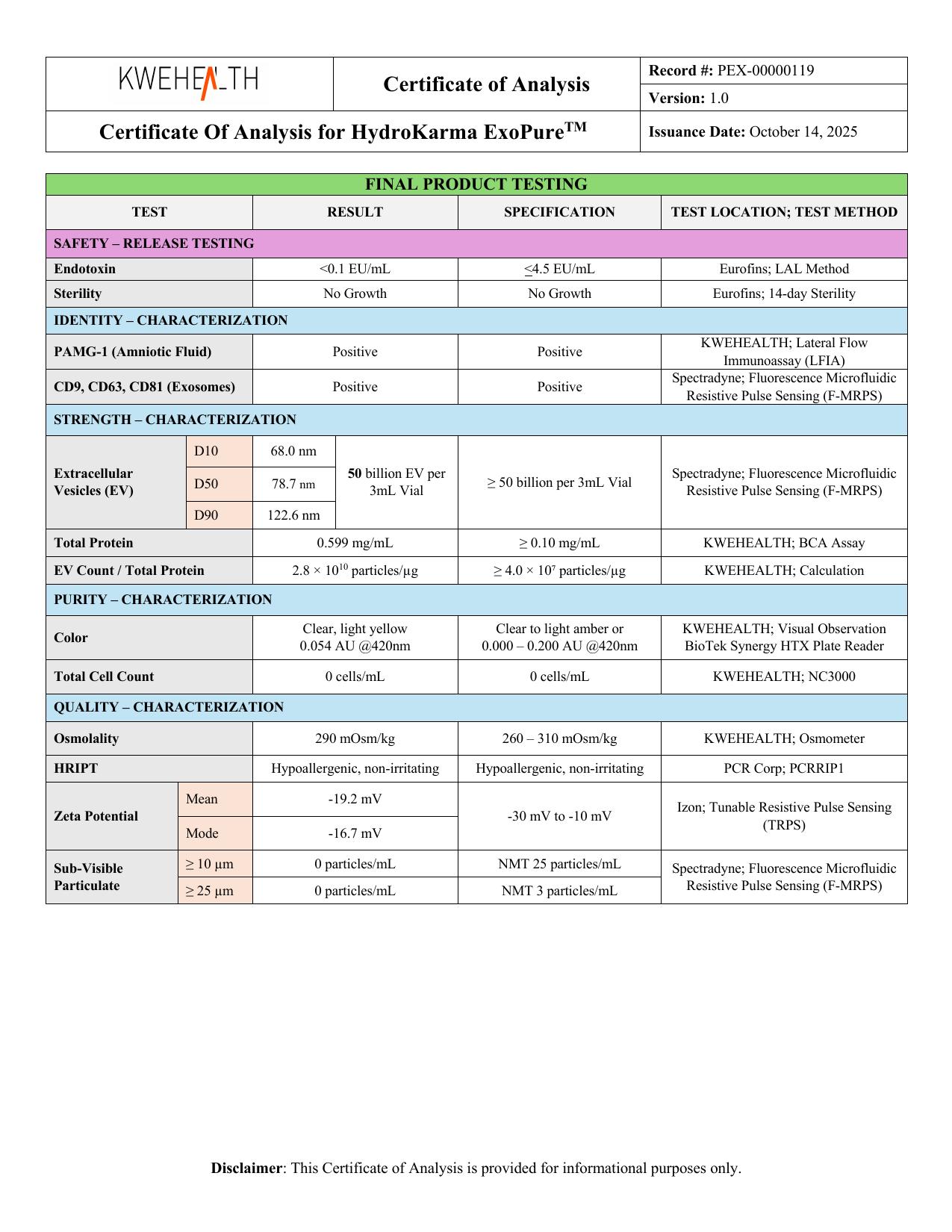
The KWEHEALTH/HydroKarma Certificate of Analysis for lot KH-0007DE reports zeta-potential measurements as part of the finished-product testing.
The COA reports:
| Measurement | Reported Result |
|---|---|
| Zeta Potential | −19.2 mV |
| Zeta Potential | −16.7 mV |
The test method is identified on KWEHEALTH's COA as:
TRPS
These are manufacturer-reported, lot-specific measurements.
They should be interpreted as characterization data for KH-0007DE, not as universal specifications for every HydroKarma lot.
And they should not be converted into unsupported claims such as:
“HydroKarma is highly stable because its zeta potential is −19.2 mV.”
The COA gives us the measured values.
Interpreting what those values mean requires the conditions and context of the measurement.
Why Are There Two Zeta-Potential Values?
Seeing two values on a COA naturally raises another question:
Why −19.2 mV and −16.7 mV?
From the supplied COA alone, we should not invent an explanation.
Two values could potentially reflect different measurements, conditions, runs, sample characteristics or reporting conventions—but unless the documentation identifies exactly what each value represents, assigning a specific explanation would be speculation.
The appropriate interpretation is therefore:
KWEHEALTH reports two zeta-potential results for this lot: −19.2 mV and −16.7 mV.
If the manufacturer provides additional documentation identifying the exact conditions or meaning of each result, that information can provide further context.
Until then, the numbers should be reported accurately without guessing.
How Is Zeta Potential Measured?
Zeta potential is commonly derived from the movement of charged particles in an applied electric field.
This behavior is known as electrophoretic mobility.
The measured mobility can then be related mathematically to zeta potential.
Different instruments and analytical approaches may use different measurement configurations and electrokinetic models.
MISEV2023 notes that some resistive-pulse-sensing platforms are capable of measuring zeta potential in addition to particle diameter and concentration.
For the HydroKarma lot discussed here, the COA identifies TRPS as the reported zeta-potential test method.
What Is TRPS?
TRPS stands for tunable resistive pulse sensing.
Resistive pulse sensing detects particles as they pass through a small pore separating conductive liquid environments.
As a particle passes through the sensing region, it temporarily changes the electrical resistance.
Those changes can be used to obtain information about individual particles.
Certain implementations can also evaluate particle movement under applied electrical conditions and derive information related to zeta potential.
It's important, however, not to confuse the measurements.
TRPS can provide physical characterization information.
It does not automatically establish:
- EV biological origin
- exosome identity
- purity
- biological activity
- safety
- effectiveness
As with the particle-sizing methods discussed in What Is Extracellular Vesicle Size and Why Does It Matter?, the analytical method tells us something specific about the preparation—not everything about it.
Why Does the Surrounding Liquid Matter?
This is one of the most important concepts in zeta-potential interpretation.
Zeta potential isn't simply an intrinsic number permanently attached to an extracellular vesicle.
The measured value depends partly on the interaction between the particle and its surrounding environment.
Factors can include:
pH
Changing pH can alter the ionization of molecules at the particle surface.
Ionic strength
The concentration of dissolved ions can affect the electrical environment surrounding particles.
Type of ions
Different ions can interact differently with charged surfaces.
Buffer composition
The medium used during measurement can influence the result.
Surface chemistry
Changes to the EV surface can influence electrokinetic behavior.
Midekessa et al. experimentally demonstrated several of these effects in EV preparations.
That means two zeta-potential measurements should not automatically be compared unless the relevant testing conditions are sufficiently comparable.
Why Comparing Zeta Potential Between Products Can Be Misleading
Imagine:
- Product A: −25 mV
- Product B: −15 mV
It may be tempting to conclude:
Product A is better because −25 is farther from zero.
That conclusion would be premature.
Before making a meaningful comparison, you would want to know whether the measurements used comparable:
- buffers
- pH
- ionic strengths
- temperatures
- particle concentrations
- instruments
- measurement procedures
- analytical models
If those conditions differ, the numerical comparison may not mean what it appears to mean.
This is the same general lesson we encounter throughout EV characterization:
Measurement context matters.
Is Zeta Potential a Stability Test?
It can provide information related to colloidal stability, but those words need to be used carefully.
Zeta potential can help researchers investigate the tendency of particles in a dispersion to repel, interact or aggregate under particular conditions.
But it does not mean:
“This product is guaranteed to remain stable for X months.”
That type of claim would require appropriate stability studies under defined storage conditions and over defined periods.
Zeta potential is therefore not a substitute for:
- shelf-life studies
- storage-validation data
- freeze-thaw studies
- particle-count monitoring over time
- size-distribution monitoring
- other appropriate stability testing
Our article What Is Cold-Chain Storage and Why Does It Matter? explains why storage conditions and preservation of product characteristics are a broader issue than one analytical measurement.
Zeta Potential and Aggregation
Aggregation occurs when particles associate into larger structures.
Because electrostatic interactions can influence particle-particle behavior, zeta potential can help researchers investigate conditions that may favor or discourage aggregation.
But aggregation itself may need to be evaluated using additional methods.
For example, changes in:
- particle-size distribution
- particle concentration
- appearance
- other physical measurements
may provide complementary information.
This is why extracellular-vesicle characterization is generally strongest when multiple analytical measurements are considered together.
Zeta Potential Is Not Particle Size
Zeta potential and particle size describe different properties.
| Measurement | Basic Question |
|---|---|
| Particle size | How large are the detected particles? |
| Particle count | How many particles are detected? |
| Zeta potential | What is the measured electrokinetic potential associated with the dispersed particles under the test conditions? |
| EV-associated markers | Were selected EV-associated proteins detected? |
| Total protein | How much protein was measured? |
None replaces the others.
For example, KH-0007DE reports:
- D10: 68.0 nm
- D50: 78.7 nm
- D90: 122.6 nm
Those numbers describe particle size.
The reported:
−19.2 mV
and
−16.7 mV
describe zeta potential.
They answer different questions.
Zeta Potential Is Not Purity
Zeta potential also shouldn't be used as a shortcut for purity.
A preparation could have a measurable negative zeta potential while still containing multiple types of particles or non-EV material.
Therefore:
zeta potential ≠ EV purity
If you want to understand how purity is evaluated, see What Is Extracellular Vesicle Purity?.
Zeta Potential Does Not Prove Exosome Identity
The same caution applies to identity.
A nanoscale particle with a negative zeta potential isn't automatically an exosome.
Many different biological and non-biological particles can carry surface charge.
Exosome terminology relates to biological origin and biogenesis.
Therefore:
negative zeta potential ≠ exosome identity
That distinction is explored further in Exosomes vs. Extracellular Vesicles: What's the Difference?.
How Should You Read Zeta Potential on a COA?
When a Certificate of Analysis reports zeta potential, ask:
1. What value was reported?
Record the actual number and its sign.
2. What units are used?
Zeta potential is commonly reported in millivolts.
3. What method was used?
Look for the analytical method or instrument.
4. Were the measurement conditions provided?
Buffer, pH, ionic strength and other conditions can matter.
5. Is the result batch-specific?
A result from one lot shouldn't automatically be generalized to every lot.
6. What other characterization data accompany it?
Particle size, concentration, markers, protein measurements and other results provide additional context.
7. Is someone turning the measurement into a claim the data don't actually support?
Be cautious if a single zeta-potential number is being used as proof of purity, identity, long-term stability or superiority.
This is why How to Read an Exosome Certificate of Analysis (COA) emphasizes reading analytical results together rather than focusing on one impressive-looking number.
What Can Zeta Potential Tell Us?
Used appropriately, zeta potential can contribute useful information about:
- particle surface-associated electrokinetic behavior
- particle-medium interactions
- colloidal behavior
- how changes in experimental conditions affect a dispersion
- potential tendencies toward particle-particle interactions under defined conditions
That's useful information.
The mistake is asking the measurement to tell us more than it actually can.
The Bigger Picture
Extracellular-vesicle characterization works best as a collection of complementary measurements.
Consider the HydroKarma COA example we've been examining throughout this Learn series.
For KH-0007DE, KWEHEALTH reports information about:
- particle quantity
- particle-size distribution
- EV-associated markers
- total protein
- particle-to-protein relationship
- cell count
- zeta potential
- sterility and other quality measurements
No one number replaces all of the others.
Instead, each measurement describes another characteristic of the tested lot.
That's the right way to think about zeta potential too.
The Bottom Line
Zeta potential is an electrokinetic measurement used to help characterize particles dispersed in liquids.
For extracellular vesicles, it can provide information related to surface-associated electrical behavior and colloidal interactions.
But its interpretation depends on experimental conditions.
Factors such as:
- pH
- ionic strength
- ion composition
- surface chemistry
- measurement method
can influence the reported value.
For HydroKarma lot KH-0007DE, KWEHEALTH reports:
−19.2 mV
and
−16.7 mV
using a method identified on the COA as TRPS.
Those are useful characterization measurements for that lot.
They are not, by themselves, proof of:
- absolute stability
- shelf life
- EV purity
- exosome identity
- biological activity
- product superiority
The best interpretation is much simpler:
Zeta potential gives us another piece of information about how a particle preparation behaves under the conditions in which it was measured.
And like every other measurement on a COA, it becomes most useful when interpreted alongside the rest of the characterization data.
Original Source / References
- Midekessa et al. — Zeta Potential of Extracellular Vesicles: Toward Understanding the Attributes that Determine Colloidal Stability. ACS Omega, 2020. DOI: 10.1021/acsomega.0c01582, PMID: 32685837. This study directly examined how factors including buffer concentration, ions, pH and other physicochemical conditions influence EV zeta potential and its interpretation in relation to colloidal stability.
- Welsh et al. — Minimal information for studies of extracellular vesicles (MISEV2023): From basic to advanced approaches. Journal of Extracellular Vesicles, 2024. DOI: 10.1002/jev2.12404, PMID: 38326288. MISEV2023 discusses EV characterization technologies and notes that zeta-potential measurement is available on some resistive-pulse-sensing platforms.
- Dissanayake et al. — Measurement of the Size and Concentration and Zeta Potential of Extracellular Vesicles Using Nanoparticle Tracking Analyzer. Methods in Molecular Biology, 2021. DOI: 10.1007/978-1-0716-1246-0_15, PMID: 33604856. This methods chapter provides additional background on EV size, concentration and zeta-potential measurement.
- KWEHEALTH/HydroKarma batch-specific Certificate of Analysis — Lot KH-0007DE. HydroKarma-specific zeta-potential values and the reported TRPS method come from KWEHEALTH's manufacturer-supplied batch documentation. The independent publications above did not test or validate HydroKarma products.
Continue Learning
What Is Extracellular Vesicle Morphology and How Is It Evaluated?
Morphology describes the observable shape and structure of extracellular vesicles. Here's how TEM, cryo-EM and AFM imaging work, why preparation affects appearance, and why an image is evidence rather than complete identification.
What Is Extracellular Vesicle Size and Why Does It Matter?
Extracellular vesicles exist across a range of nanoscale sizes. Here's what nanometer measurements mean, how D10, D50 and D90 describe a size distribution, and why size is one piece of characterization evidence rather than proof of identity.
Understanding Extracellular Vesicle Characterization and Testing
Characterization is how laboratories measure and describe different properties of an extracellular-vesicle preparation — particle count, particle size, EV-associated markers, total protein and zeta potential — and why no single test describes everything.
How to Read an Exosome Certificate of Analysis (COA)
A plain-English walkthrough of an extracellular-vesicle Certificate of Analysis: lot numbers, analytical methods, particle concentration, particle size, characterization, specifications and results.